Pregnancy changes the body quickly.
Your centre of gravity shifts. Your posture changes. Your breathing can feel different. Joints may feel less stable. Everyday movements such as getting out of bed, climbing stairs or simply standing for long periods can suddenly require more effort.
At the same time, many women hear completely opposite advice about exercise.
One person says, “Rest as much as possible.”
Another says, “Keep doing exactly what you were doing before.”
Social media adds another layer of confusion, with pregnant women performing advanced workouts that may have little to do with what your body needs.
The better question is not, “How much can I still do?”
It is:
“What kind of movement will support me through this stage of pregnancy?”
For many women with uncomplicated pregnancies, exercise is not only allowed, it is encouraged. Both the American College of Obstetricians and Gynecologists and the NHS recommend regular physical activity during pregnancy when there are no medical or obstetric reasons to avoid it.
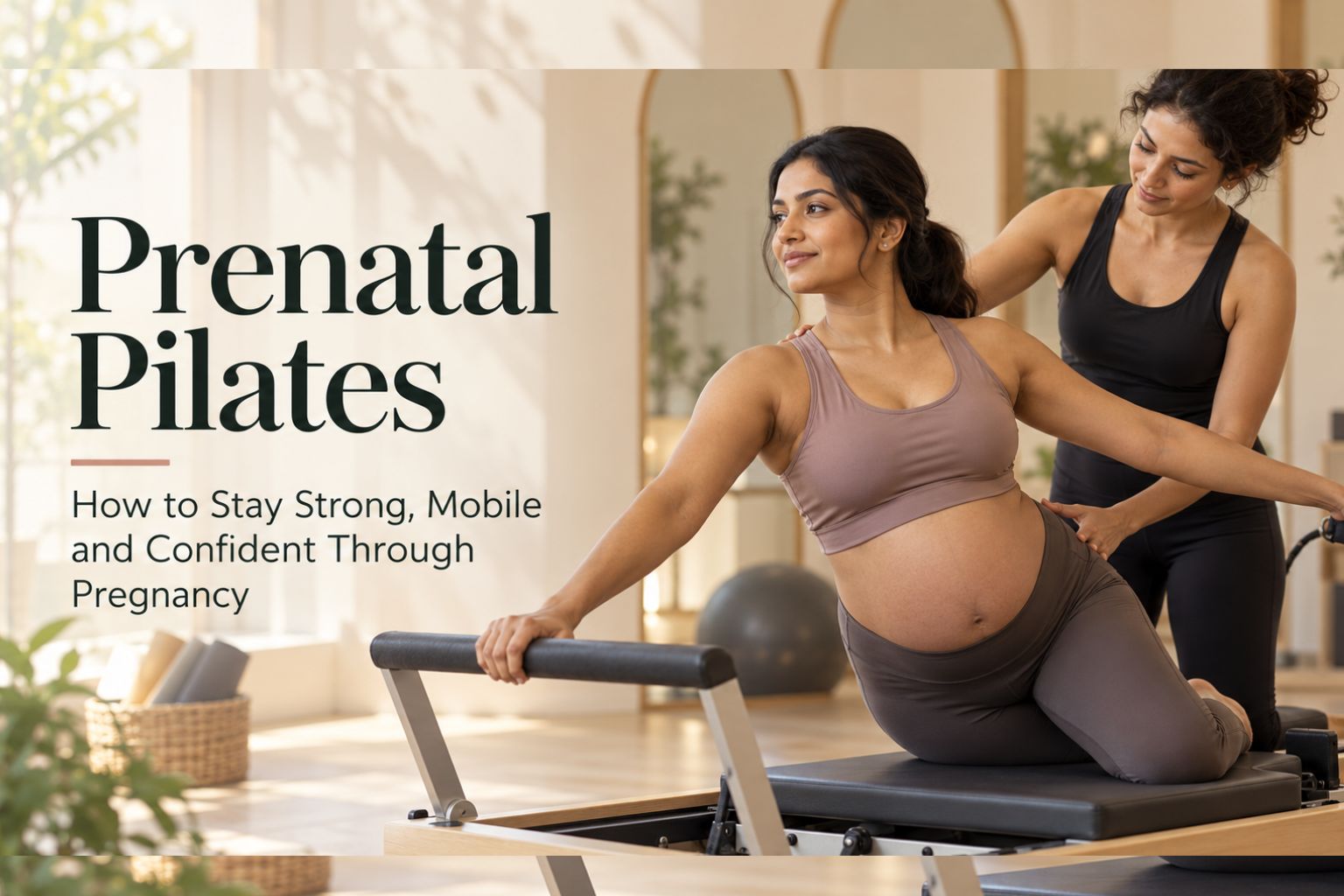
Prenatal Pilates can be one part of that movement plan when it is taught appropriately and adapted as pregnancy progresses.
It should not be about proving that pregnancy has not changed you.
It should help you move with those changes intelligently.
This article is educational. Every pregnancy is different. Discuss exercise with your obstetrician or maternity care provider, particularly if you have complications, symptoms or have been advised to restrict activity.
Is Exercise Safe During Pregnancy?
For most women with healthy, uncomplicated pregnancies, yes.
ACOG states that physical activity during pregnancy is generally safe and desirable in the absence of contraindications. The NHS recommends working toward 150 minutes of moderate intensity activity each week, including muscle strengthening activity, while adjusting exercise according to comfort and pregnancy stage.
Moderate intensity does not mean pushing yourself until you are exhausted. A simple guide is the “talk test”: you should generally be able to hold a conversation while exercising.
If you were active before pregnancy, you may often continue many familiar activities with appropriate modifications and your doctor’s approval.
If you were not exercising regularly before pregnancy, this is not the time to suddenly begin an aggressive programme. Start gradually.
The goal is consistency, not intensity for its own sake.
Why Pregnancy Changes the Way You Move
Pregnancy does not simply add weight to your abdomen. It changes the physical environment in which your entire body moves.
Your centre of gravity shifts
As the abdomen grows, your weight distribution changes. Balance can feel different, especially later in pregnancy. Movements that were automatic before may require more attention.
Your joints may feel different
Hormonal changes during pregnancy affect ligaments and joint stability. That does not mean you should stop strengthening. It means control becomes especially important.
Your breathing mechanics change
As pregnancy progresses, the growing uterus changes the space available to the diaphragm. You may notice that breathing during exercise feels different from before.
Your abdominal wall adapts
The abdominal wall lengthens and changes as the uterus expands. Trying to train your abdomen exactly as you did before pregnancy may not make sense.
The pelvic floor carries increasing load
The pelvic floor is part of the support system at the base of the pelvis. Pregnancy itself increases the demands placed on these muscles, regardless of whether your eventual delivery is vaginal or caesarean.
This is why prenatal exercise should evolve as your pregnancy evolves.
What Makes Pilates Useful During Pregnancy?
Pilates is not automatically “prenatal” just because it is gentle or done on a Reformer.
A prenatal Pilates programme should be deliberately adapted to the pregnant body.
When taught appropriately, Pilates can work on several qualities that are useful during pregnancy.
1. Strength Without Chasing Exhaustion
Pregnancy still requires strength.
You need leg strength to stand and climb stairs. Hip strength can support movement and balance. Your upper body will eventually do a surprising amount of carrying. Your trunk still needs to organise movement even while the abdominal wall changes.
Pilates can provide resistance through body weight, springs and small equipment without making exhaustion the only measure of a successful session.
That can be valuable when energy levels fluctuate from week to week.
Some days you may feel strong.
Some days simply showing up and moving well is enough.
2. Better Awareness of Posture and Alignment
As your centre of gravity changes, the body naturally adapts.
You may notice more arching through the lower back, changes in rib position, shoulders drifting forward or a different way of standing.
The objective is not to force yourself into a rigid “perfect posture.”
Instead, Pilates can help you notice where you are holding unnecessary tension and build strength to support changing positions more comfortably.
That awareness becomes useful outside the studio when you are sitting, sleeping, working, walking and eventually carrying your baby.
3. Breathing and Trunk Coordination
Breathing is central to Pilates.
During pregnancy, it becomes even more valuable because breath, abdominal control and pelvic floor function are closely connected.
Rather than holding your breath during effort, you can learn to exhale through challenging phases of movement and avoid unnecessary straining.
This does not mean there is one “correct pregnancy breath.”
It means learning to keep breathing while producing effort and allowing the trunk to adapt rather than gripping everything as tightly as possible.
4. Pelvic Floor Awareness
Pelvic floor exercises are commonly recommended during pregnancy.
But pelvic floor training is not only about squeezing harder.
These muscles need to contract, relax and coordinate with breathing and movement.
The NHS specifically recommends pelvic floor exercises during pregnancy. Learning how to connect with these muscles can be useful preparation for both pregnancy and postnatal recovery.
If you experience pelvic pain, significant heaviness, leakage or difficulty feeling the pelvic floor, a pelvic health physiotherapist may be the appropriate professional to assess you.
Pilates can support pelvic floor awareness, but it should not replace specialist pelvic health care when symptoms require it.
5. Mobility Without Forcing Range
Pregnancy can create stiffness in some areas while making other areas feel more mobile.
Pilates can help maintain comfortable movement through the hips, upper back, shoulders and ankles without chasing extreme flexibility.
More range is not automatically better.
Useful mobility is range you can control.
That becomes particularly important when joint stability is changing.
What Changes Across the Trimesters?
There is no universal trimester workout that suits every woman.
Still, your programme should normally change as the pregnancy progresses.
First trimester
Some women feel almost normal physically. Others experience nausea, fatigue, dizziness or major changes in energy.
If you were already active and your pregnancy is uncomplicated, you may be able to continue many familiar exercises with adjustments.
The biggest mistake is assuming that because the bump is small, the body has not changed.
Fatigue and overheating can still matter.
Second trimester
As the abdomen becomes more prominent, balance and body position become more relevant.
Exercises lying flat on the back for prolonged periods are usually modified as pregnancy progresses. Both ACOG and NHS guidance advise avoiding prolonged supine exercise later in pregnancy because the uterus can compress major blood vessels and contribute to dizziness or reduced blood return.
A Pilates programme can use side lying, seated, kneeling, standing, inclined and supported positions instead.
Third trimester
Comfort and function usually become the priority.
The session may include more supported positions, balance work, hip strength, upper body work, breathing and movements that help you continue daily activity comfortably.
The goal is not to maintain the same repertoire until the final week.
Good prenatal programming changes with you.
What About Reformer Pilates During Pregnancy?
The Reformer can be very useful because spring resistance and body position can be adjusted easily.
But the machine does not make an exercise safe by itself.
The instructor still needs to consider your trimester, symptoms, balance, comfort, previous Pilates experience and medical guidance.
For example, the Reformer can allow an exercise to be performed in side lying or seated positions instead of lying flat. Springs can support a movement or add resistance. Range can be shortened. Balance demands can be reduced.
That flexibility is one reason personalised Reformer Pilates can work well during pregnancy.
But modifications should be intentional, not improvised halfway through a normal class.
Can You Start Pilates for the First Time While Pregnant?
In many uncomplicated pregnancies, women can begin appropriate exercise even if they were not very active before.
But “starting Pilates” during pregnancy should look different from beginning an advanced general fitness programme.
A beginner needs time to understand the equipment, breathing, alignment and cueing even without pregnancy.
Add pregnancy changes, and the need for good instruction becomes even more important.
Start gradually.
Do not compare your spring settings, range or exercise level with women who were practising Pilates before becoming pregnant.
Your goal is not to catch up.
Your goal is to build a movement practice your body can use now.
Which Exercises Should Be Avoided During Pregnancy?
There is no single blacklist that applies identically to every pregnancy, but several principles matter.
Activities with a high risk of falling, abdominal impact or collision are generally avoided. Hot Pilates should also be avoided because overheating is a concern in pregnancy.
As pregnancy progresses, prolonged exercise flat on the back is usually modified.
Exercises that create discomfort, dizziness, pain, unusual breathlessness or a feeling that something is simply not right should stop.
Some advanced Pilates movements may become unsuitable because of balance, abdominal pressure, range or position even if you could perform them easily before pregnancy.
A good instructor should be comfortable removing an exercise entirely rather than trying to preserve an impressive repertoire.
Pregnancy is not the time to prove that you can still do everything.
Warning Signs to Stop Exercise
ACOG advises stopping exercise and contacting your healthcare provider if you experience warning signs such as vaginal bleeding, painful regular contractions, leakage of amniotic fluid, dizziness, chest pain, headache, significant shortness of breath before exertion, muscle weakness affecting balance, or calf pain or swelling.
You should also stop if you feel unwell or experience symptoms that concern you.
There is no prize for finishing the session despite a warning sign.
Is Prenatal Pilates Good for Back Pain?
Back discomfort is common during pregnancy, but not every case has the same cause.
Exercise can help some women stay stronger and more mobile, and ACOG lists reduced back pain among the potential benefits of regular exercise during pregnancy.
Pilates may help by working on hip strength, trunk control, posture awareness, breathing and movement variety.
But severe, new or worsening pain should not simply be treated as something to exercise through.
If pain is persistent, radiating, associated with neurological symptoms or affecting normal function, speak with your doctor or physiotherapist.
Prenatal Pilates should support an appropriate care plan, not replace diagnosis.
Do You Need Pelvic Floor Exercises if You Plan a Caesarean Birth?
Yes, pelvic floor awareness can still be relevant.
Pregnancy itself places increased load on the pelvic floor. The pelvic floor is also part of the wider trunk system used during breathing and movement.
A planned caesarean changes the mode of delivery, but it does not erase the physical demands of pregnancy.
That said, pelvic floor symptoms should be assessed individually rather than assuming every woman simply needs more contractions.
Why One to One Pilates Can Be Valuable During Pregnancy
Pregnancy can be unpredictable.
A movement that felt comfortable two weeks ago may feel completely different today.
One to one Pilates gives the instructor more opportunity to adjust position, resistance, range and pace according to how you are presenting that day.
It can be particularly useful when you are new to Pilates, have a history of pain, are returning after a previous pregnancy complication, or simply want greater confidence around modifications.
Some experienced, healthy pregnant clients may be comfortable in a small group designed to accommodate pregnancy.
The format should follow your needs rather than forcing your pregnancy into a standard class.
Exercise During Pregnancy Is Not About “Staying Small”
Pregnancy fitness marketing can become very appearance focused.
“Keep your body.”
“Only gain belly weight.”
“Bounce back faster.”
Those messages can turn a healthy movement practice into another source of pressure.
Exercise during pregnancy has much more meaningful goals.
Maintain strength.
Support cardiovascular health.
Keep moving comfortably.
Manage stress.
Prepare physically for the demands of birth, recovery and motherhood.
Feel connected to a body that is changing quickly.
Your pregnancy is not a body transformation challenge.
It is a major physiological event.
Your exercise should respect that.
How We Approach Prenatal Pilates at Essenzaa
At Essenzaa Pilates in Indore, prenatal Pilates begins with understanding your pregnancy, exercise history, current symptoms and medical guidance before deciding how you should move.
Programming is guided by STOTT PILATES® principles and adapted as the pregnancy progresses.
The focus is not on maintaining advanced exercises for as long as possible.
It is on preserving useful strength, mobility, breathing, control and confidence while respecting the changes happening in your body.
For women who need more individual attention, one to one Pilates allows the session to change as your pregnancy changes.
Where medical or pelvic health input is required, Pilates should work alongside your healthcare team.
Frequently Asked Questions
Is Pilates safe in the first trimester?
For most women with uncomplicated pregnancies, appropriately programmed exercise can be safe in the first trimester. Discuss exercise with your obstetric care provider, especially if you have medical or obstetric complications.
Can I do Reformer Pilates while pregnant?
Many women can, provided the programme is appropriately modified for pregnancy and their individual circumstances. The instructor should know you are pregnant and understand prenatal modifications.
How often should I exercise during pregnancy?
General guidance recommends working toward 150 minutes of moderate intensity activity each week when medically appropriate. This can include different forms of movement rather than only Pilates.
Can Pilates help my pelvic floor during pregnancy?
Pilates can support breathing, trunk control and pelvic floor awareness. Persistent leakage, pelvic pain, heaviness or other pelvic floor symptoms should be assessed by an appropriate healthcare professional or pelvic health physiotherapist.
Should I stop abdominal exercises during pregnancy?
Not necessarily. The abdominal wall still needs function and strength, but exercise selection, position, load and pressure management may need to change as pregnancy progresses. Generic pre-pregnancy abdominal routines may no longer be appropriate.
When should I stop Pilates during pregnancy?
Stop if you develop warning symptoms, feel unwell or receive medical advice to restrict activity. Pregnancy exercise should be adapted throughout, not continued automatically regardless of how you feel.
Move With the Body You Have Today
Pregnancy asks your body to change almost every week.
Your exercise programme should be allowed to change too.
You do not need to prove that you are as strong as you were before pregnancy.
You need strength that supports the life your body is living now.
At Essenzaa, prenatal Pilates is built around that idea: understand first, adapt intelligently, and keep movement supportive rather than performative.
Because during pregnancy, good exercise is not about doing more.
It is about doing what serves you now.