Your physiotherapy sessions are finished. The pain is better. Your doctor or physiotherapist has told you that you can start exercising again.
And yet you still hesitate before joining a class, lifting a weight, running, bending deeply or doing the activity you used to enjoy.
Being medically cleared to move and feeling confident enough to move are not always the same thing.
This space between rehabilitation and normal exercise is where many people get stuck. They are no longer in the acute stage of an injury, but they do not feel ready to return to a normal gym or a fast group class. They may know the few exercises they were given during rehabilitation, but they are unsure how to turn those exercises into a stronger body again.
This is where appropriately programmed Pilates can sometimes become useful: not as a replacement for physiotherapy, but as a bridge from rehabilitation into progressively more demanding movement.
Physiotherapy and Pilates Do Different Jobs
Physiotherapy is a healthcare profession. A physiotherapist can assess, diagnose and treat many movement related conditions, manage rehabilitation after injury or surgery, and decide when a person is ready to progress.
Pilates is an exercise method. It can be used to develop strength, mobility, coordination, balance and body awareness. A Pilates instructor should not diagnose an injury simply because a client describes pain.
That distinction matters. The best transition happens when each professional stays within scope and the client does not feel forced to choose between ‘rehab’ and ‘fitness’ as if they are competing approaches.
Why the End of Physiotherapy Can Feel Like the Beginning of Another Journey
Rehabilitation usually has milestones. Pain settles. Swelling reduces. Range of motion improves. Strength starts returning. You regain the ability to complete daily tasks or specific tests.
But real life is rarely as controlled as a treatment room.
You may need to carry luggage, sit through a long flight, return to running, play padel, climb stairs repeatedly, lift a child or work a full day without thinking about the body part that used to hurt.
NHS rehabilitation guidance on returning to activity emphasises gradual progression, rebuilding strength and movement, reintroducing activity step by step and monitoring how the body responds. That gradual return is important because recovery is not simply a switch from injured to normal.
The Problem With Going From Rehab Straight Back to Your Old Workout
A common mistake is returning immediately to the exact training level you had before the problem started.
If you were previously running five kilometres, you try five kilometres again. If you were lifting a certain weight, you return to the same weight. If you played a full match, you go straight back to a full match.
Your symptoms may be improved, but your tolerance to volume, speed, load and repeated effort may not yet be back.
A second common mistake is the opposite: avoiding movement for so long that the body becomes deconditioned and confidence keeps shrinking.
The more useful middle ground is graded exposure: rebuilding capacity in steps that are challenging enough to create adaptation but controlled enough to recover from.
Where Pilates Can Fit After Physiotherapy
Pilates can offer a structured environment where resistance, range, speed, support and complexity are easy to adjust.
1. Rebuilding control before adding more load
Sometimes the problem is not that you cannot produce force. It is that you struggle to control where the force goes. Pilates can slow a movement down and make you notice what your pelvis, spine, shoulder, knee or foot is doing while the rest of the body moves.
2. Progressing from isolated rehab exercises to whole body movement
Rehabilitation may initially focus on a specific area. Long term movement requires the whole body to cooperate. A knee does not run by itself. A shoulder does not swim by itself. A back does not lift a suitcase without the hips, legs, trunk and arms contributing.
Pilates can gradually connect those areas through larger movement patterns while still allowing exercises to be modified.
3. Rebuilding confidence under resistance
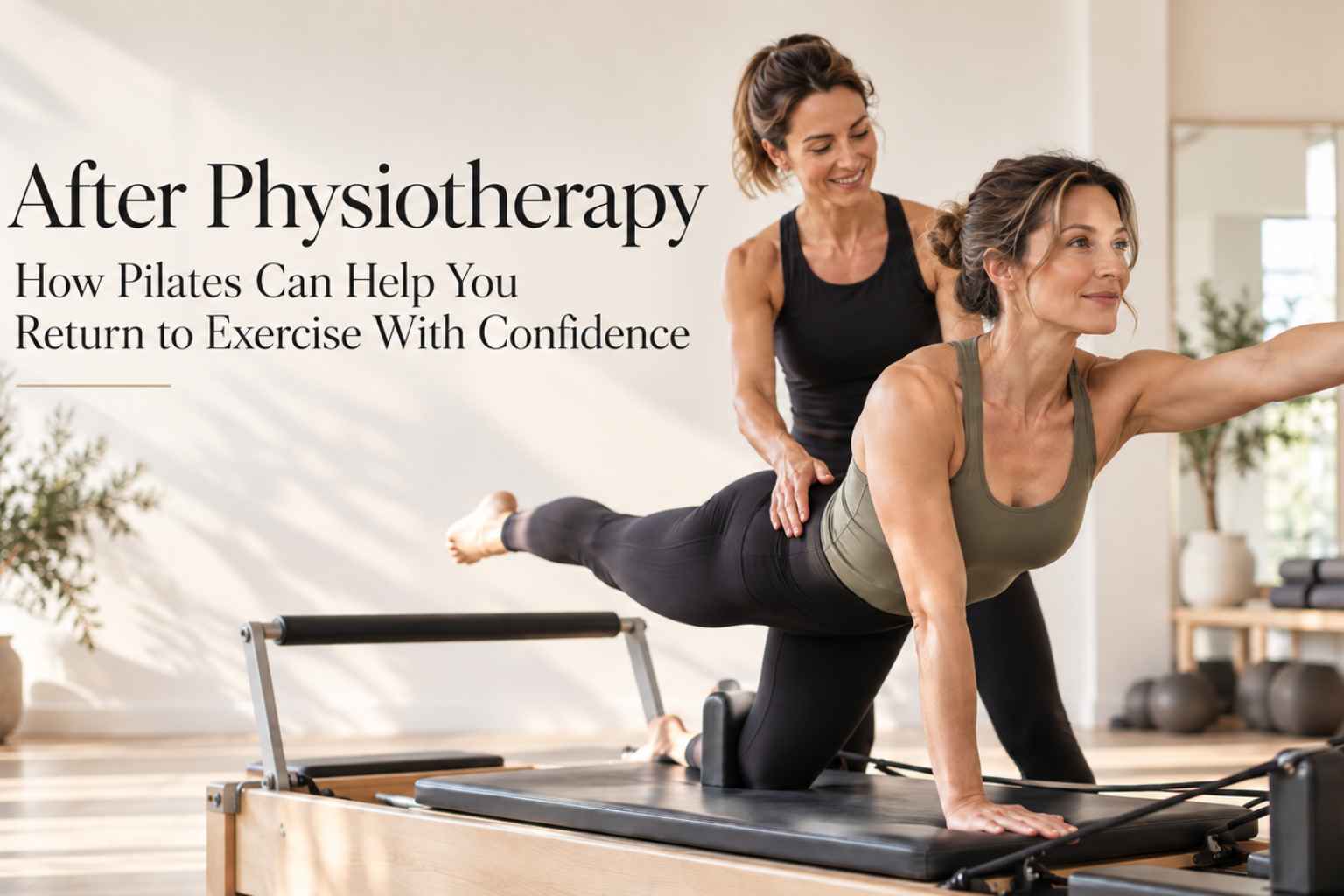
The Reformer uses springs, which can create resistance or assistance. This gives an instructor options for reintroducing load without immediately jumping to the most demanding version of an exercise.
The goal is not to make the body permanently dependent on supported movement. It is to use the support strategically while strength and confidence increase.
4. Restoring movement variety
After pain or injury, people often become very good at moving around the uncomfortable area. They twist differently, avoid one leg, stop rotating, or hold the trunk rigid because it feels safer.
As appropriate for the condition, progressive Pilates can reintroduce flexion, extension, rotation, lateral movement, pushing, pulling and weight transfer in a controlled way.
What About Back Pain After Physiotherapy?
Persistent low back pain is one area where fear and avoidance can become particularly strong.
The World Health Organization’s guideline for chronic primary low back pain includes exercise programmes and education that supports self care among recommended non surgical approaches. The guideline also emphasises person centred, holistic care rather than relying on a single intervention.
That does not mean every back problem should be treated with the same Pilates routine. Disc conditions, neurological symptoms, fractures, inflammatory disease, recent surgery and other diagnoses may require different medical pathways.
But once the relevant healthcare professional has cleared a client for exercise, the next question often becomes: how do we help this person build capacity without making fear the centre of every session?
What About Knee Pain or Returning to Running?
A runner may finish physiotherapy with improved knee pain but still need better single leg strength, hip control, calf capacity, balance and confidence before returning to normal mileage.
NHS return to running guidance emphasises objective readiness, gradual reintroduction of impact and enough recovery between runs. Pilates can support some of the strength and control pieces, but it cannot replace the actual graded running that prepares a runner to run.
That distinction is important. Pilates should support the activity you want to return to, not pretend to be the activity itself.
How Do You Know Whether You Are Ready for Post Rehabilitation Pilates?
There is no universal timeline because the answer depends on the injury, surgery or condition.
A useful starting point is that the treating professional has cleared you for the type of exercise you are considering and that your current symptoms are stable enough for progressive training.
Before starting, share relevant information including your diagnosis, imaging where appropriate, surgery history, restrictions, what physiotherapy involved, what still causes symptoms, and the activities you want to return to.
If your physiotherapist has given specific precautions or exercises to continue, those should be respected rather than ignored because you have entered a Pilates studio.
When Pilates Is Not the Right Next Step Yet
You should not use Pilates to bypass medical advice.
Seek appropriate healthcare review if you have new or worsening neurological symptoms, significant unexplained pain, increasing swelling, loss of function, fever, recent trauma, changes in bladder or bowel control, or any symptom your medical team has told you requires review.
After surgery, follow the timelines and restrictions given by your surgeon and physiotherapist. A Pilates instructor should work around those restrictions, not overrule them.
Why One to One Pilates May Be Better at the Beginning
A group class assumes that most participants can follow the general session safely with reasonable modifications.
That may not be the best environment when you are newly returning from rehabilitation. One to one Pilates gives the instructor more time to understand your history, observe how you move, select appropriate spring resistance and change the exercise immediately if something is not suitable.
As your confidence and independence improve, a smaller group may become appropriate. The format should follow readiness, not price alone.
Why Assessment Matters More Than the Name of the Exercise
People often ask, ‘Which Pilates exercise is best for my knee?’ or ‘Which Reformer exercise is safest for my back?’
The same exercise can be helpful for one person, unnecessary for another and inappropriate for someone else depending on the diagnosis, stage of recovery, range, resistance and technique.
That is why exercise selection should come after understanding the person. The name of an exercise tells you far less than how, why and when it is being used.
What a Good Transition Programme Should Build
A useful post rehabilitation programme should progressively restore more than one quality.
- Strength to tolerate the demands of daily life, exercise and sport.
- Mobility where movement remains unnecessarily restricted.
- Control so joints and body segments can manage load efficiently.
- Balance and coordination when these are relevant to the activity.
- Endurance so good movement can be maintained when fatigue appears.
- Confidence to stop treating normal movement as a threat.
Eventually, the programme should become less about the old injury and more about the life you want to return to.
Post Rehabilitation Does Not Mean Permanent Gentle Exercise
This is an important point.
Some people remain in ‘rehab mode’ for years. Every session is cautious. Every exercise is basic. Nothing progresses because the old injury remains the centre of attention.
But the purpose of rehabilitation and post rehabilitation training is to restore capacity. When the body is ready, resistance should progress. Balance can become more challenging. Movements can become more complex. Cardio or sport specific work can return.
Intelligent exercise is not the same as permanently easy exercise.
How Essenzaa Approaches the Transition From Rehabilitation to Pilates
At Essenzaa Pilates in Indore, clients with a medical or rehabilitation history are not automatically placed into a standard group workout.
The starting point is understanding the history, present symptoms, posture, movement patterns, current capacity and the guidance already given by the client’s healthcare team. When appropriate, one to one Pilates can then focus on progressively rebuilding movement, strength and confidence using the STOTT PILATES® framework and personalised programming.
Where continued medical or physiotherapy input is needed, Pilates should work alongside that care rather than compete with it.
The goal is not to keep you feeling like a patient. The goal is to help you become capable enough to return to your life.
What Progress Should Look Like After Rehabilitation
Progress is not only having zero symptoms. It can also mean tolerating more load, recovering faster, moving through a larger range, needing fewer modifications and returning to activities you had been avoiding.
For someone with a back history, progress may mean sitting through a workday without constantly changing position. For someone after a knee problem, it may mean climbing stairs confidently before returning to running. For a shoulder client, it may mean reaching overhead with control before adding speed or heavier resistance.
These changes are useful because they show that the body is becoming more capable rather than simply less painful. Pain can fluctuate for many reasons. Capacity gives you another way to measure whether the programme is moving forward.
How Pilates and Physiotherapy Can Work Together
The transition is smoother when communication is clear. If your physiotherapist has identified movements to avoid temporarily, strength targets to reach or exercises that remain important, share that information with your Pilates instructor.
Likewise, if Pilates repeatedly brings up symptoms that were not present during rehabilitation, do not simply keep modifying forever without feedback. It may be useful to return to the physiotherapist or doctor for reassessment.
The client should not have to act as though the two worlds are separate. Healthcare can address diagnosis, healing and rehabilitation needs, while Pilates can progressively expand movement once the person is ready.
A Simple Example of the Bridge Back to Exercise
Imagine a woman who has completed physiotherapy after a knee problem. She can walk comfortably and manage stairs, but she is nervous about returning to her normal gym and weekend padel games.
Her early Pilates sessions may focus on controlled leg strength, hip stability, calf work, balance and trunk control. As she improves, resistance can increase, single leg work can become more demanding and movement can become faster or more complex. Separately, she gradually returns to court drills and then to actual games according to the guidance she has been given.
The Pilates is not pretending to be padel rehabilitation. It is building physical qualities that help her tolerate the next stage of her own activity.
Frequently Asked Questions
Can I start Pilates immediately after physiotherapy finishes?
Possibly, but the end date of physiotherapy is not the only factor. Your diagnosis, current symptoms, restrictions and the type of Pilates you plan to do all matter. Ask your physiotherapist whether you are cleared for progressive exercise.
Is Reformer Pilates rehabilitation?
Reformer Pilates is exercise. It may be used within rehabilitation by appropriately qualified healthcare professionals, but a normal Pilates session should not be presented as medical rehabilitation unless it is actually being delivered within that clinical scope.
Can Pilates help after a knee injury?
Pilates can help develop qualities such as leg strength, hip control, balance and movement awareness. Whether it is appropriate depends on the specific knee condition and stage of recovery.
Can Pilates help me return to running?
It can support trunk and lower body strength, control and mobility, but you still need a graded return to running to rebuild impact tolerance and running specific capacity.
Should I tell my Pilates instructor about an old injury if it no longer hurts?
Yes. An old injury may still be relevant to how you move or how quickly certain exercises should progress. It does not need to define your programme, but it is useful information.
From Recovery to Capability
Finishing physiotherapy is a meaningful milestone, but it does not have to be the point where guidance suddenly disappears.
The next stage is learning to trust your body under gradually increasing demands.
That may mean Pilates. It may mean strength training, walking, swimming, running or returning to your sport. Often it means a combination.
At Essenzaa, post rehabilitation Pilates is not about keeping you in a protected bubble. It is about helping you build enough understanding, control and strength to move beyond it.
References
World Health Organization: Guideline for non surgical management of chronic primary low back pain
Leeds Community Healthcare NHS Trust: Return to activity or sport after injury
Berkshire Healthcare NHS Foundation Trust: Return to running programmeMerrithew: STOTT PILATES® Frequently Asked Questions