Knee pain has a way of making ordinary life feel complicated.
You start thinking before taking the stairs.
You avoid sitting too low because getting up may hurt.
You reduce your walking.
Running becomes something you “used to do.”
And when someone suggests exercise, the first thought is often:
“Won’t that make my knee worse?”
Sometimes rest is necessary for an acute injury.
But for many common knee problems, long term improvement requires the opposite of permanent avoidance: the body needs to gradually regain strength and capacity.
The knee also does not work in isolation.
Every step involves the foot, ankle, hip, pelvis and trunk. If you only look at the painful joint, you may miss the wider movement pattern that influences how the knee is being loaded.
This is where appropriately programmed Pilates can be useful.
Not because Pilates has a magical knee exercise.
But because it gives us different ways to strengthen the legs and hips, train balance, control alignment and progressively rebuild confidence in movement.
This article is educational and does not diagnose knee conditions. Sudden injury, major swelling, locking, instability, inability to bear weight, significant trauma or persistent worsening pain should be assessed by an appropriate doctor or physiotherapist.
Knee Pain Is a Symptom, Not One Diagnosis
“Knee pain” can describe many different situations.
Osteoarthritis.
Patellofemoral pain.
Tendon irritation.
Meniscal injury.
Ligament injury.
Pain following surgery.
Pain that appears only during running.
Pain that appears mainly on stairs.
These problems are not interchangeable.
That is why a generic list of “best exercises for knee pain” can only go so far.
The right programme depends on what is actually happening, what stage of recovery you are in and what activity you want to return to.
If you have already been medically assessed or completed physiotherapy, Pilates may sometimes become part of the next stage of rebuilding strength and movement confidence.
Why Exercise Is Often Part of Knee Care
For osteoarthritis, NICE recommends therapeutic exercise tailored to the person, including local muscle strengthening and general aerobic fitness. It also notes that discomfort may temporarily increase when exercise begins, but consistent exercise can improve pain, function and quality of life over time.
This is an important message because many people stop moving as soon as the knee hurts.
Less activity can then lead to less strength.
Less strength can make everyday tasks more demanding.
Confidence falls.
Activity reduces further.
A better approach is usually to find a level of movement the knee can tolerate and gradually build from there, rather than expecting either complete rest or immediate return to full activity.
The Knee Needs the Hip More Than Most People Realise
When you walk, run, climb stairs or stand on one leg, the hip helps control the position of the thigh.
If hip strength and control are limited, the knee may have to manage movement differently.
That does not mean every knee problem is “caused by weak glutes.”
Bodies are more complicated than one muscle explanation.
But hip strength, single leg control and pelvic stability are commonly relevant when rebuilding lower body function.
Pilates offers many ways to train those areas without treating the knee as the only body part that matters.
The Foot and Ankle Matter Too
The knee sits between the hip and the foot.
What happens below it matters.
Ankle mobility, calf strength and foot control all influence walking, squatting, stair climbing and running.
For example, if the ankle cannot move comfortably as you descend a stair, your body may find another strategy somewhere else.
If calf strength is poor, running and repeated stair work become harder.
A complete programme looks up and down the chain rather than simply repeating knee extensions forever.
What Pilates Can Work On
1. Controlled leg strength
Pilates can strengthen the quadriceps, hamstrings, glutes and calves through different positions and resistance levels.
On the Reformer, spring resistance can be adjusted so the exercise is challenging without immediately demanding full body weight.
That can be useful when rebuilding confidence.
2. Hip stability
Side lying work, standing exercises, bridging variations, split stance work and controlled single leg tasks can challenge the muscles around the hips.
The aim is to help the pelvis and thigh stay organised as load increases.
3. Alignment awareness
People often hear the instruction “keep your knee in line.”
But awareness is not the same as forcing the knee into one perfect track.
Pilates can slow movements down enough for you to notice what happens at the hip, knee and foot under load.
That feedback is useful when learning a squat, lunge or step pattern.
4. Balance and single leg control
Walking and running are essentially repeated single leg activities.
If you want to return to those activities, balance and single leg control matter.
Pilates can progress from supported balance to more demanding standing work as confidence improves.
5. Trunk control
The trunk influences how force is transferred through the lower body.
A runner or padel player may have strong legs but still lose control through the pelvis and trunk when fatigue arrives.
Pilates can challenge the body to keep one area stable while another moves, which is useful preparation for more complex activity.
Is Pilates Good for Knee Osteoarthritis?
Research is encouraging but should be interpreted carefully.
A 2025 systematic review and meta analysis of randomised trials found that Pilates may help reduce pain and improve function in people with knee osteoarthritis compared with no intervention. However, the certainty of evidence was low, and Pilates was not clearly superior to conventional exercise.
Another 2025 review reached a similar conclusion: Pilates may be a useful exercise option, but it should not be presented as uniquely better than other well designed exercise programmes.
That is actually a useful message.
You do not need one “perfect” exercise method.
You need an exercise programme you can do consistently that progressively improves the qualities your knee and your life require.
For some women, Pilates fits that role very well.
What if Your Knee Hurts on Stairs?
Stairs demand strength, control and range from the entire lower body.
Going downstairs is often harder because the leg must control your body weight as you lower yourself.
If stairs are one of your main problems, useful training may include:
Quadriceps strength.
Hip strength.
Calf strength.
Ankle mobility.
Balance.
Controlled step patterns.
The objective is not to avoid stairs forever.
It is to gradually make your body better prepared for them.
What if You Want to Return to Running?
Running adds repeated impact and higher loading demands than walking.
Pilates can support runners by improving hip strength, trunk control, balance, calf work and single leg stability.
But Pilates cannot replace running if your goal is to run.
Impact tolerance has to be rebuilt through a graded return to running.
This is where many people make one of two mistakes.
They either return to their old mileage immediately because the knee feels better.
Or they stay in low load rehab exercises for months because they are afraid to test the knee.
The useful middle ground is progressive exposure.
Build strength.
Reintroduce impact gradually.
Monitor symptoms.
Increase volume in steps.
If you are returning after injury, follow the guidance of your physiotherapist or doctor.
Does Knee Pain Mean You Should Avoid Squats?
Not automatically.
Squatting is a normal human movement.
You sit in a chair.
You stand up.
You lower yourself to pick something up.
The question is not simply, “Are squats bad for knees?”
The better questions are:
What depth can you control?
How much load can you tolerate?
What happens at the hip and ankle?
Is the movement painful?
How does the knee respond afterwards?
A partial squat with support may be appropriate at one stage. A deeper or more heavily loaded squat may be appropriate later.
Exercise should progress with capacity.
What About Lunges?
The same principle applies.
A lunge can be modified by changing range, support, stance length and resistance.
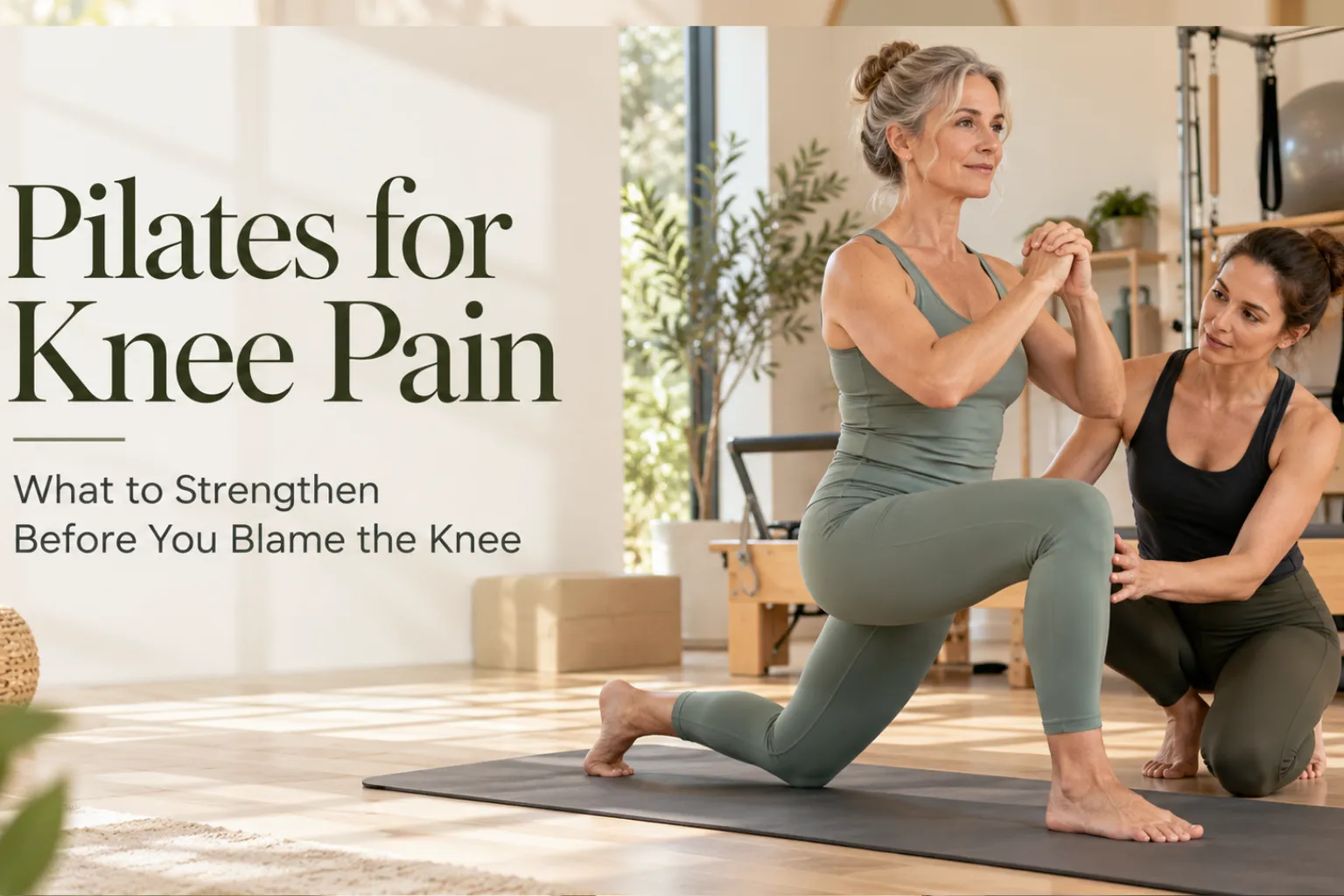
For someone returning from knee pain, a supported split stance exercise may be a useful starting point before deeper lunges or faster sport movements.
The exercise name matters less than the dose.
Range, load, speed, volume and recovery determine whether a movement is appropriate.
Why the Reformer Can Be Useful for Knee Strength
The Reformer provides adjustable spring resistance and different body positions.
That means a client can strengthen the legs while lying down, seated, kneeling or standing depending on the goal.
For someone nervous about full weight bearing, lying footwork can provide an early way to load the legs with support.
Later, standing work can increase balance and functional demand.
But the Reformer should not become a way to permanently avoid normal weight bearing.
If your goal is stairs, walking, running or sport, your programme eventually needs to prepare you for those tasks.
Pain During Exercise: How Much Is Too Much?
There is no universal pain number that works for every condition.
Some people with osteoarthritis may experience mild discomfort when they begin strengthening, and NICE specifically advises that temporary increases in pain can occur when therapeutic exercise starts.
But sharp pain, swelling that keeps increasing, instability, locking or symptoms that worsen significantly after exercise deserve attention.
A good programme looks at the response during the session and the recovery afterwards.
If your knee is repeatedly more irritated the next day, the dose may need adjusting.
Progress is not created by ignoring every symptom.
Neither is it created by avoiding every sensation.
Why One to One Pilates Can Be Better at the Beginning
If your knee problem is recent, complex or linked to a previous injury, one to one Pilates can give the instructor more time to observe how you squat, step, balance and control the leg.
The session can be changed immediately if a certain range or resistance is not suitable.
As your confidence improves, you may be ready for a small group format.
The goal should be increasing independence, not creating permanent dependence on individual sessions.
How We Approach Knee Pain at Essenzaa
At Essenzaa Pilates in Indore, knee pain is not treated as a reason to simply avoid using the knee.
We first want to understand the history, diagnosis where available, current symptoms, previous physiotherapy, daily limitations and the activities you want to return to.
Then we look at the wider movement picture: hip strength, foot and ankle control, balance, trunk stability and how the leg behaves under gradually increasing load.
For clients returning after rehabilitation or managing a specific condition, one to one Pilates may be the most appropriate starting point.
Programming is guided by STOTT PILATES® principles, with modifications and progression based on the individual rather than a generic “knee routine.”
Where symptoms require medical or physiotherapy assessment, we refer back rather than trying to exercise through uncertainty.
How to Measure Progress Beyond Pain
Pain matters, but it should not be your only measure.
Look for practical changes.
Can you climb stairs more confidently?
Can you walk farther before the knee becomes tired?
Can you stand from a chair without using your hands?
Can you control a single leg movement better?
Can you return to running gradually?
Are you recovering faster after activity?
These changes show that your body is becoming more capable.
That is often a more useful long term target than expecting every sensation to disappear immediately.
Frequently Asked Questions
Is Reformer Pilates good for knee pain?
It can be useful because resistance and body position can be adjusted, allowing lower body strength and control to progress gradually. Whether it is appropriate depends on the cause of your knee pain and your stage of recovery.
Can Pilates help knee osteoarthritis?
Research suggests Pilates may improve pain and function compared with no exercise in some people with knee osteoarthritis, but evidence quality is limited and Pilates is not clearly superior to other appropriate exercise programmes.
Should I exercise if my knee hurts?
Many knee conditions benefit from appropriately dosed exercise, but sudden injury, significant swelling, locking, instability, major trauma or worsening symptoms should be assessed by a healthcare professional.
Is walking good for knee pain?
Walking can be valuable for general activity and fitness, but the appropriate amount depends on your symptoms and diagnosis. Strength training is often also important because walking alone may not rebuild all the capacity your knee needs.
Can Pilates help me run again after knee pain?
Pilates can support strength, balance and control, but a graded return to running is still required to rebuild impact tolerance. If you are returning after injury, coordinate the process with your physiotherapist or doctor.
Are squats bad for knee pain?
Not necessarily. Squats can often be modified by changing depth, support and load. The right version depends on your diagnosis, symptoms and current capacity.
Your Knee Needs Capacity, Not Fear
A painful knee can make you smaller in ways you do not notice at first.
One less walk.
One less flight of stairs.
One less game.
One more reason to sit down.
The goal of intelligent exercise is to reverse that process gradually.
Not by pretending pain does not exist.
By building enough strength, control and confidence that your knee can participate in life again.
Pilates can be part of that journey when it is appropriately programmed.
At Essenzaa, we do not begin with the question, “Which knee exercise should you do?”
We begin with a better question:
“What does your body need to do again?”
References
- National Institute for Health and Care Excellence. Osteoarthritis in over 16s: diagnosis and management.
- Zhang K, et al. The efficacy and safety of Pilates exercise in patients with knee osteoarthritis: a systematic review with meta analysis of randomised controlled trials. Annals of Medicine, 2025.
- Effect of Pilates Exercise on Health Related Outcomes in Patients With Knee Osteoarthritis: A Systematic Review and Meta Analysis, 2025.