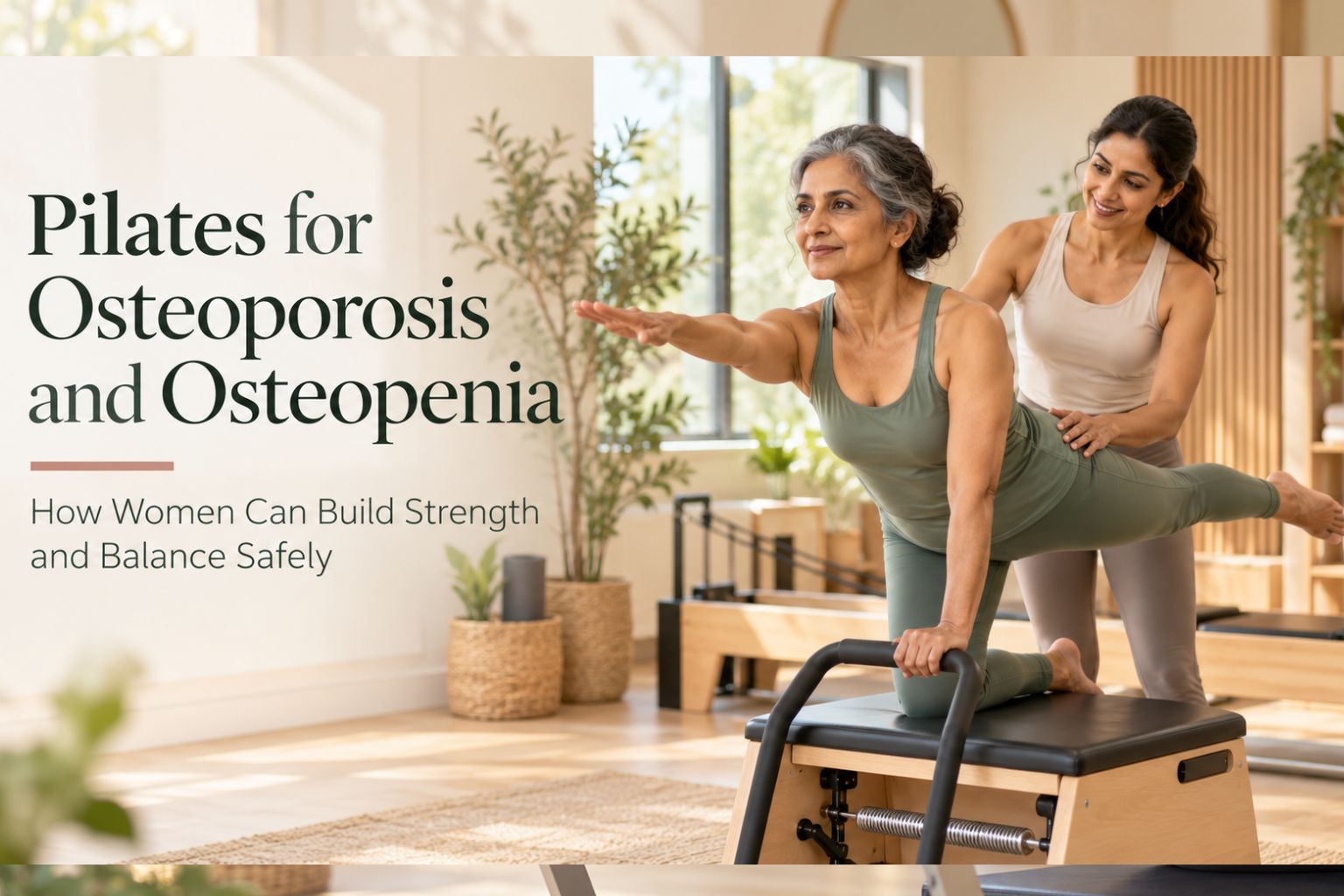
A diagnosis of osteopenia or osteoporosis can change the way a woman thinks about movement almost overnight.
Before the scan, you may have climbed stairs, bent forward, travelled, lifted bags and exercised without thinking much about your bones.
After the diagnosis, even ordinary movements can suddenly feel risky.
Should I stop bending?
Can I lift weights?
Is Pilates safe for osteoporosis?
Can exercise actually help my bones?
What if I fracture my spine without knowing it?
The understandable response is often to become more cautious.
But becoming less active is usually not the answer.
Bones respond to load. Muscles respond to resistance. Balance improves when it is trained. And staying physically capable is an important part of reducing the consequences of osteoporosis as we age.
The real question is not whether a woman with osteoporosis should move.
It is how she should move, what she should strengthen, what may need modifying and how her fracture risk changes the programme.
Pilates can be part of that plan, but it needs to be used for what it does well and modified where necessary.
This article is educational and does not replace medical or physiotherapy advice. If you have osteoporosis with spinal fractures, multiple previous fractures, recent fracture, significant pain or other medical concerns, speak with your doctor or physiotherapist before starting a new exercise programme.
Osteopenia and Osteoporosis: What Is the Difference?
Both terms relate to bone mineral density, but they are not the same diagnosis.
Osteopenia means bone density is lower than expected but has not reached the diagnostic threshold for osteoporosis.
Osteoporosis means bone strength is reduced enough that fracture risk is increased.
A bone density scan is only part of the picture. Age, previous fractures, medications, menopause, family history and other health factors also influence fracture risk.
This matters for exercise because two women with the same scan result may not require the same level of caution.
One may be active, strong and have no fracture history.
Another may have already experienced vertebral fractures and need significantly more modification.
The label should inform the programme, not replace individual assessment.
Why Exercise Matters for Bone Health
The Royal Osteoporosis Society explains that bones become stronger when they are loaded through activity. It recommends both impact exercise and strength exercise, while also emphasising balance work to reduce falls.
The International Osteoporosis Foundation similarly highlights weight bearing activity, resistance training and balance as important components of exercise for bone health.
This gives us an important principle:
If your goal is stronger bones, gentle movement alone may not be enough.
You need appropriate loading.
That may include walking, stair climbing, dancing or other impact activity where suitable, plus progressive resistance exercise.
Pilates can contribute to strength, posture, balance and movement confidence, but it should not be marketed as the only exercise a woman needs for osteoporosis.
Where Pilates Can Help
Pilates has several qualities that can be useful for women with osteopenia or osteoporosis.
1. Strength and muscular support
Pilates can progressively strengthen the hips, legs, trunk, back and upper body using springs, body weight and other resistance.
Strong muscles matter because they help you move more confidently and support everyday tasks such as rising from a chair, climbing stairs, carrying bags and maintaining posture.
Resistance training is also one of the exercise types recommended for bone health.
The important word is progressive.
If resistance never increases and the body is never challenged, the training stimulus may remain too small.
2. Balance
Falls are a major concern in osteoporosis because a fall can lead to fracture.
Balance is trainable.
Pilates can include standing work, single leg control, changes in base of support, coordination and trunk stability.
The Royal Osteoporosis Society specifically includes Pilates among activities that may help improve strength and balance.
For some women, better balance may be one of the most practical reasons to exercise.
3. Posture and spinal extensor strength
With osteoporosis, especially where vertebral fractures are a concern, the ability to support an upright posture becomes important.
Pilates can strengthen the muscles around the upper back, hips and trunk and teach controlled movement without relying on repeated spinal flexion.
The goal is not to force the spine perfectly straight.
It is to build enough strength and awareness to move with more support.
4. Confidence
Fear can quietly reduce activity after an osteoporosis diagnosis.
A woman stops lifting.
Then she stops bending.
Then she avoids travel, stairs or uneven ground.
Over time, that loss of activity can reduce strength and confidence further.
Appropriately supervised exercise can help rebuild trust in what your body can do.
That psychological benefit matters.
Is Pilates Safe With Osteoporosis?
Usually, yes, with appropriate exercise selection and modification.
The Royal Osteoporosis Society states that most people with osteoporosis can exercise safely and specifically provides guidance for practising Pilates with osteoporosis.
But not every traditional Pilates exercise is automatically suitable.
Certain movements that involve loaded, repeated or end range spinal flexion may need modification, particularly for women at higher risk of vertebral fracture.
This includes some familiar movements such as deep roll downs, curl ups, repeated toe touching or heavily rounded spinal loading.
That does not mean you can never bend forward in daily life.
It means the way you bend, the amount of load, the speed and your fracture history matter.
Why Spinal Flexion Needs More Thought
The Royal Osteoporosis Society advises that people with osteoporosis may need to adapt exercises that involve excessive spinal flexion, especially when the spine is loaded in a rounded position.
A safer strategy for many daily tasks is learning a hip hinge: bending from the hips while keeping the spine more organised rather than collapsing through the back.
This is useful beyond Pilates.
Think about picking something from the floor.
Loading a washing machine.
Lifting a suitcase.
Gardening.
Getting something from a low cupboard.
The goal is not to live afraid of flexion.
It is to understand when a different movement strategy may reduce unnecessary spinal stress.
What About Rotation?
Rotation is part of normal life.
You turn to look behind you, reach for a seat belt, move in the kitchen and change direction while walking.
But aggressive, loaded or end range twisting may need modification in people with osteoporosis, especially where spinal fractures or high fracture risk are present.
An instructor should distinguish between gentle controlled rotation and forcing the spine into a range because an exercise traditionally includes it.
Pilates should adapt to the person.
The person should not have to adapt to the choreography.
Does Pilates Build Bone Density?
This question needs a careful answer.
Pilates can create muscular resistance and can contribute to bone health, particularly when weight bearing and resistance are appropriately programmed.
But bone adaptation responds strongly to mechanical loading, and organisations such as the Royal Osteoporosis Society recommend a combination of strength and impact exercise where appropriate.
That means a complete bone health programme may include Pilates plus walking, stair climbing, resistance training and suitable impact activity depending on your fracture risk and medical guidance.
Swimming and cycling are excellent for cardiovascular fitness but provide less bone loading because your body weight is supported.
No single exercise method needs to do every job.
Osteoporosis Does Not Mean You Need Only Gentle Exercise
This is one of the biggest misunderstandings after diagnosis.
Women are sometimes told to be careful and translate that into “never challenge yourself.”
But muscles and bones need enough stimulus to adapt.
The answer is not reckless exercise.
It is intelligent progression.
For one woman, progress may mean moving from supported squats to stronger leg resistance.
For another, it may mean standing balance work before adding movement.
For someone with no spinal fractures, appropriate impact work may eventually become part of the plan.
For someone with multiple vertebral fractures, the programme may stay lower impact while still progressing strength.
Safe does not have to mean easy forever.
Why Women After Menopause Need to Think About Bone Health
Bone loss accelerates around menopause because of hormonal changes, particularly the decline in oestrogen.
This is one reason women in their forties and fifties should think about bone health before a fracture happens.
Strength training, weight bearing activity, adequate nutrition and appropriate medical screening all matter.
Pilates can help build the movement qualities that make those activities easier to sustain: balance, trunk control, hip strength, posture and confidence.
But a beautiful Reformer class does not replace the need for broader bone health care.
If you have risk factors, discuss bone density screening and medical management with your healthcare provider.
What if You Already Have a Spinal Fracture?
A previous vertebral fracture changes the conversation.
You may need more specific advice about spinal loading, impact and movement ranges.
The Royal Osteoporosis Society advises people with spinal fractures or multiple previous fractures to seek guidance from a doctor or physiotherapist before starting new exercise.
This does not mean exercise is off limits.
In fact, maintaining strength and mobility can be extremely important.
But a standard group class may not be the best place to begin if the instructor does not know your fracture history or cannot adapt the programme appropriately.
One to one work or a clinically informed exercise plan may be a better starting point.
Reformer Pilates and Osteoporosis
The Reformer can be useful because springs allow resistance and assistance to be adjusted.
It can help strengthen the legs, hips, arms and trunk and can support different body positions.
But again, the machine is not the safety system.
The instructor is.
A Reformer class that includes repeated loaded spinal flexion or unsuitable twisting is not automatically safe simply because the equipment looks controlled.
Good programming considers fracture risk first, then chooses exercises.
Why Standing Work Matters
Some Pilates sessions spend most of their time lying down.
That can be useful for learning control and building strength, but women concerned about bone health and falls also need time on their feet when appropriate.
Standing work challenges balance, hip strength, ankle control and the ability to manage gravity in the position where falls actually happen.
The Royal Osteoporosis Society recommends balance exercise at least two days per week and emphasises strength and impact activity for bone health.
So a complete programme should not become permanently floor based.
What About Walking?
Walking is valuable.
It supports cardiovascular health, keeps you active and provides low impact weight bearing exercise.
But walking alone may not provide enough resistance to build all the muscle strength you need, especially as you age.
This is why combining walking with progressive resistance exercise can be more useful than choosing one or the other.
A woman who walks daily and adds appropriately programmed Pilates or strength training is covering different physical qualities.
Can You Do Pilates if You Have Osteopenia but No Fractures?
Often, yes.
Osteopenia is a valuable early signal that bone health deserves attention.
If you have no fracture history and no other major limitations, you may be able to exercise relatively normally while building appropriate strength and impact over time.
Still, tell your instructor about the diagnosis.
It helps them make better choices, particularly around repeated loaded flexion, high risk balance work and progression.
Why Assessment Matters
“Osteoporosis” is not enough information to design a programme.
A useful assessment should consider:
Your age and activity level.
Any previous fractures.
Whether you have had spinal fractures.
Current pain.
Balance.
Strength.
Confidence with movement.
Other medical conditions.
What you actually need your body to do.
A 52 year old woman with osteopenia who wants to keep playing tennis has different needs from a 72 year old woman recovering from a vertebral fracture.
Both need movement.
They do not need the same movement.
How We Approach Bone Aware Pilates at Essenzaa
At Essenzaa Pilates in Indore, women with osteopenia, osteoporosis or a history of fracture are not treated as if they simply need a gentler version of a normal class.
The first step is understanding medical history, fracture history, posture, balance, strength and current movement confidence.
Where appropriate, Pilates can then be programmed to build useful strength, balance and movement control while modifying exercises that may place unnecessary stress on the spine.
Our approach is guided by STOTT PILATES® principles and personalised progression.
If a woman has spinal fractures, recent fractures or needs medical rehabilitation, we encourage coordination with her doctor or physiotherapist.
The goal is not to make you afraid of movement.
It is to make movement safer, stronger and more useful.
Frequently Asked Questions
Is Pilates good for osteoporosis?
Pilates can help improve muscle strength, balance, posture and movement confidence. It can be part of a bone health programme, but some exercises may need modification and Pilates should not replace recommended impact, resistance or medical treatment where those are appropriate.
Can I do Reformer Pilates with osteoporosis?
Often yes, but the programme should reflect your fracture risk and history. The Reformer can provide useful resistance and assistance, but exercise selection matters more than the machine itself.
Which Pilates exercises should I avoid with osteoporosis?
Exercises involving excessive, repeated or loaded spinal flexion may need modification, particularly if you are at higher risk of vertebral fracture. Your doctor, physiotherapist or appropriately informed instructor can help determine what is suitable for you.
Does Pilates increase bone density?
Pilates can contribute resistance and weight bearing exercise, but bone health guidance generally recommends combining progressive strength exercise with appropriate impact activity where safe. It is better to think of Pilates as one part of a broader bone health plan.
Is walking enough for osteoporosis?
Walking is valuable low impact weight bearing exercise, but strength training and balance work are also important. Depending on your fracture risk, additional impact exercise may be appropriate.
Should women over 50 do strength training?
For most women, yes. Muscle strengthening is recommended for health and becomes increasingly important for maintaining strength, function and bone health with age. The correct level depends on your health and experience.
Strong Bones Need More Than Caution
An osteoporosis diagnosis should make your movement more informed.
It should not make your life smaller.
The objective is to become strong enough to keep doing the things that matter: travelling, climbing stairs, lifting, walking, playing with grandchildren, exercising and living independently.
Pilates can help build some of the physical qualities that support that life.
But the best programme is not the one that avoids everything.
It is the one that understands your risk, challenges you appropriately and progresses as your confidence grows.
At Essenzaa, that is where we begin: not with fear, and not with a generic class.
With understanding.
References
- Royal Osteoporosis Society. Pilates and osteoporosis.
- Royal Osteoporosis Society. Exercise for bones.
- Royal Osteoporosis Society. How to exercise safely for bones.
International Osteoporosis Foundation. Exercise and osteoporosis.