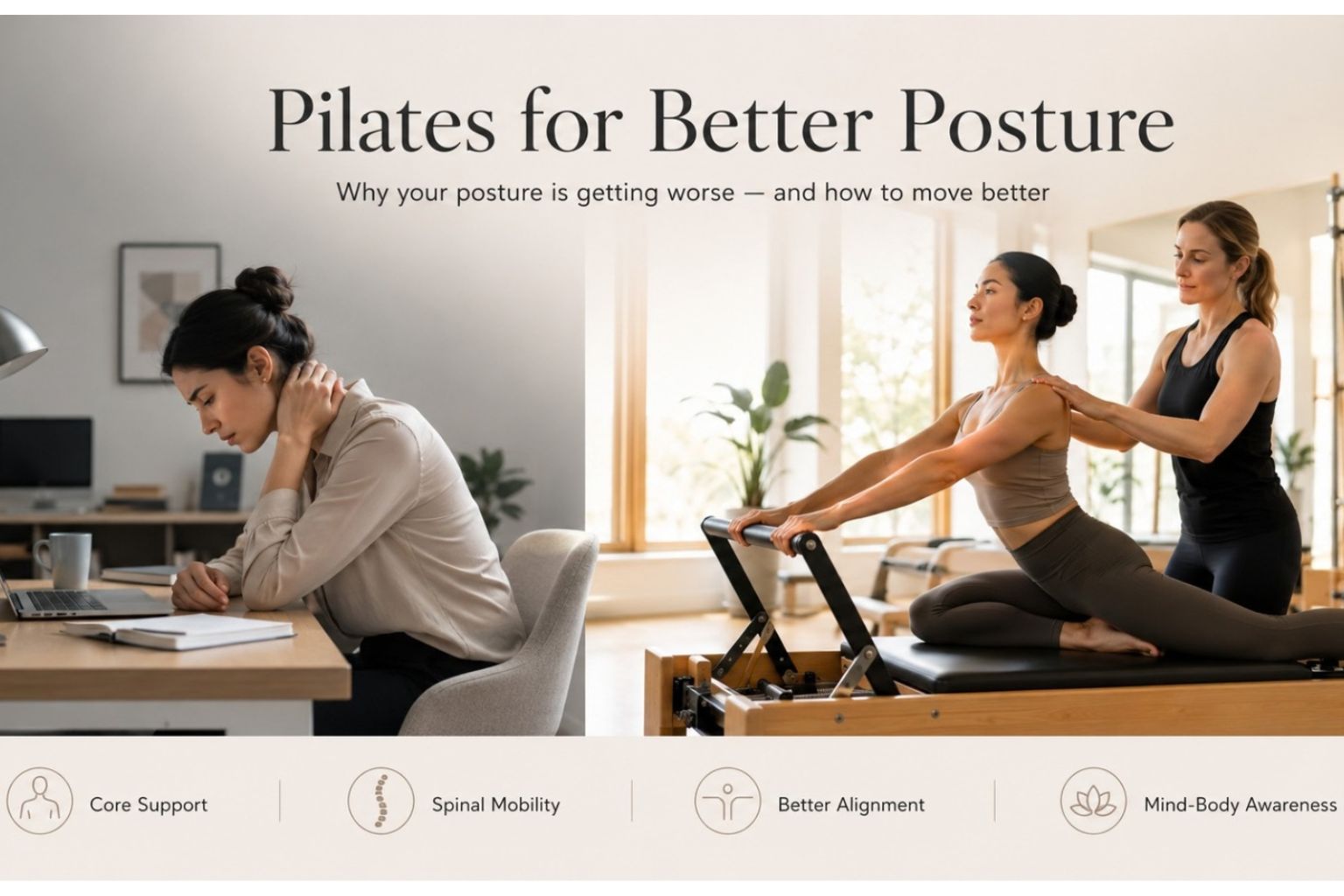
You sit up straight.
Five minutes later, your shoulders have moved forward again.
By the end of the workday, your neck feels tight, your upper back feels stiff, and sitting “properly” starts to feel like another task you have to remember.
Sound familiar?
Many women start searching for posture correction exercises, stretches or a workout to help posture because they assume the solution is simply to strengthen their back or remind themselves to sit straighter.
But posture is more complex than that.
Your posture is influenced by how you breathe, how your spine moves, how well your core supports you, how your shoulders and hips work, and—most importantly—how your body moves throughout the day.
That is why Pilates for better posture is not really about forcing your body into a perfect position.
It is about teaching your body to move with better awareness, control and support.
First: There Is No One “Perfect” Posture
We often think good posture means:
Shoulders back. Stomach in. Chest up. Sit straight.
But your body was never designed to hold one rigid position for eight hours.
Posture is dynamic.
Your body needs to be able to sit, stand, bend, rotate, reach, walk and change positions comfortably.
The problem often begins when we spend long periods doing the same thing.
Think about a normal working day:
- Laptop in front of you
- Phone in your hand
- Hours spent sitting
- Driving between places
- Very little movement through the upper back
- Shoulders repeatedly moving forward
- Limited movement through the hips
- Stress changing the way you breathe
Over time, certain movement patterns can start feeling “normal” simply because your body repeats them so often.
This is why occasionally pulling your shoulders back may not create lasting change.
Your body needs more than a reminder.
It needs better movement options.
Why Posture Correction Exercises Alone May Not Be Enough
There is nothing wrong with searching for exercises to improve posture or exercises for better posture.
Movement and exercise absolutely matter.
The World Health Organization includes physical activity, exercise and strategies that improve strength and movement among important approaches for managing many cases of non-specific low back pain.
The important question is:
Which exercise does your body actually need?
One woman may have limited mobility through her upper back.
Another may move well but lack trunk control.
Someone else may hold excessive tension through her neck and shoulders.
Another may struggle to connect her breathing with her core.
Giving every woman the same five “posture exercises” assumes every body has the same problem.
It doesn’t.
That is one reason a more complete movement system can be useful.
How Pilates Approaches Posture Differently
Pilates does not train posture as one isolated position.
It works on the systems that help your body support itself while you move.
Research examining Pilates and body posture has found promising improvements in several measures of postural alignment, although the quality and certainty of evidence varies depending on the population and body area studied. In other words, Pilates has potential—but it should not be presented as a guaranteed posture “fix.”
A well-designed Pilates practice typically works across several areas at the same time.
1. Your Core Learns to Support You
When most people hear “core”, they immediately think of abs.
But your core does much more than create visible abdominal definition.
It helps manage force between your upper and lower body and contributes to control around your trunk and pelvis.
This is why effective core strengthening exercises are not simply about doing more crunches.
Pilates teaches you to create support while breathing and moving.
Instead of repeatedly “sucking your stomach in”, you learn how your abdominal muscles, pelvis, rib cage and breathing work together.
A good core strength routine should ultimately help you use that strength during real movement—not only while lying on a mat.
2. You Develop Stability Without Becoming Rigid
Good posture needs both mobility and stability.
Too much stiffness is not the goal.
Neither is uncontrolled movement.
This is where core and stability exercises become particularly important.
During Pilates, you may be asked to keep one part of your body organised while another part moves.
For example:
Your arms may move while your rib cage stays controlled.
Your legs may move while your pelvis remains stable.
You may rotate your spine while learning not to compensate elsewhere.
These small details are what make Pilates feel very different from simply completing repetitions.
You are learning how to move.
3. Your Spine Gets More Opportunities to Move
After hours at a desk, many of us realise we have barely moved our spine through its available ranges all day.
Pilates incorporates controlled movements involving:
- Flexion
- Extension
- Rotation
- Lateral movement
- Articulation
- Stability
The goal isn’t to make your spine endlessly flexible.
The goal is to develop a body that can move when movement is required and stabilise when stability is required.
This is one reason people interested in Pilates for spine health are often attracted to the method.
Pilates encourages controlled movement rather than simply holding the body in one fixed position.
4. Your Shoulders Learn to Work With Your Rib Cage
If your shoulders constantly feel like they are creeping toward your ears, simply pulling them “back and down” all day may not be the answer.
Your shoulder blades need to move.
Your rib cage needs to move.
Your upper spine needs to move.
And your breathing influences all of them.
Pilates pays close attention to this relationship.
Instead of treating your shoulders as an isolated body part, your instructor can observe how your arms, shoulder blades, ribs and spine behave together.
That matters for women who spend hours:
- Working on laptops
- Driving
- Looking at phones
- Carrying children
- Travelling
- Working in positions that repeatedly bring the arms forward
Sometimes what feels like “bad shoulders” is part of a much bigger movement pattern.
5. You Become More Aware of What Your Body Is Doing
This may be one of the most underestimated benefits of Pilates.
Many posture habits happen without us noticing them.
You don’t consciously decide to shift onto one hip while standing.
You don’t deliberately raise one shoulder while typing.
You may not realise that you hold your breath when concentrating.
You may not notice that every time your arms move overhead, your ribs move with them.
Pilates slows movement down enough for you to notice these patterns.
And once you can feel something, you have a much better chance of changing it.
That is why progress isn’t always about becoming “stronger” as quickly as possible.
Sometimes the first improvement is simply:
“I can finally feel what my body is doing.”
Can Pilates Help With Back Pain?
This deserves a careful answer.
Pilates for back pain is widely searched online, and exercise can be helpful for many people with non-specific back pain.
A systematic review and meta-analysis has examined Pilates as an intervention for low back pain, and health organisations including the NHS also list Pilates among activities that may help some people with back pain.
But back pain is not one condition with one solution.
Pain can have many causes.
If you have:
- Severe or worsening pain
- Pain following an injury
- Persistent unexplained pain
- Numbness or weakness
- Symptoms affecting normal daily activities
- A diagnosed spinal or medical condition
you should seek appropriate medical or physiotherapy advice rather than relying on a generic online exercise routine.
At Essenzaa, we believe movement should begin with understanding—not guessing.
Why Assessment Matters Before Choosing Your Exercises
Imagine two women walk into a Pilates studio.
Both say:
“My posture is bad.”
They sound like they have the same goal.
But when they move, their bodies may tell completely different stories.
One may need more thoracic mobility.
One may need better core control.
One may need hip mobility.
One may need shoulder stability.
One may simply need more movement variety during her day.
This is why randomly collecting posture correction exercises from different videos can sometimes miss the bigger picture.
The exercise itself isn’t always the most important part.
The reason you are doing it matters.
And so does how you perform it.
Mat Pilates or Reformer Pilates for Posture?
Both can be valuable.
Mat Pilates teaches you to control your own body against gravity and can be extremely effective when taught with precision.
Reformer Pilates adds spring resistance and assistance, allowing exercises to be adapted in many different ways.
The Reformer can help an instructor:
- Change resistance
- Support certain movements
- Challenge stability
- Work on alignment
- Progress strength
- Modify exercises for the individual
Neither is automatically “better”.
The right choice depends on your body, experience and goals.
The instructor and the quality of the programming matter far more than simply choosing a piece of equipment.
What About a Daily Posture Workout?
If your goal is better posture, don’t think only about your 50-minute workout.
Think about the other 23 hours of your day too.
Your workout to help posture can support you, but movement habits outside the studio still matter.
Try thinking in terms of movement variety:
Change positions regularly.
Stand when you have been sitting for a long time.
Walk whenever possible.
Move your shoulders.
Allow your upper back to rotate.
Pay attention to how you breathe when stressed.
Build strength progressively.
The NHS also recommends staying active rather than remaining inactive for prolonged periods when dealing with many forms of back discomfort.
You don’t need to spend your entire day trying to maintain a “perfect” posture.
You need a body that has enough strength, mobility and awareness to adapt.
How We Approach Posture at Essenzaa Pilates
At Essenzaa Pilates in Indore, we don’t begin by handing every woman the same list of exercises.
We begin by understanding how your body moves.
We observe patterns such as your posture, breathing, spinal movement, shoulder position, pelvis and overall movement control.
From there, your Pilates experience can be adapted around what your body actually needs.
Our approach is rooted in the globally recognised STOTT PILATES® methodology by Merrithew®, with an emphasis on precision, alignment, control and intelligent movement.
Because two women can walk through our door with the same complaint—
“My posture doesn’t feel right.”
—and need completely different guidance.
That is why at Essenzaa, assessment comes before assumptions.
Better Posture Is Not About Looking Perfect
Perhaps the goal shouldn’t be:
“I need perfect posture.”
A better goal might be:
“I want my body to support me better through my day.”
You want to sit without constantly feeling exhausted.
Stand without unnecessary tension.
Move without feeling stiff.
Train without simply pushing through discomfort.
And become more aware of your body before small movement habits become bigger limitations.
Pilates doesn’t ask you to hold yourself perfectly.
It teaches you to understand yourself better.
And that can change far more than how you look when you stand.
Frequently Asked Questions
Is Pilates good for posture?
Pilates can help develop core control, spinal mobility, strength, body awareness and movement coordination—all of which can contribute to better postural control. Research on Pilates and postural alignment is encouraging, although results vary and it should not be viewed as a guaranteed correction for every posture issue.
How long does Pilates take to improve posture?
There is no universal number of sessions. Your starting point, movement habits, consistency, lifestyle and individual needs all matter. Rather than focusing only on appearance, notice improvements in movement awareness, control, strength and comfort.
What are the best exercises to improve posture?
There isn’t one universal list of exercises to improve posture for everyone. Effective programming may involve mobility, strength, breathing, spinal movement and core and stability exercises depending on what your body needs.
Are core strengthening exercises enough for better posture?
Core strength can be important, but posture involves more than your abdominal muscles. Your spine, hips, shoulders, breathing and everyday movement patterns also contribute.
Is Reformer Pilates better than normal exercise for posture?
Not necessarily. Reformer Pilates provides useful resistance and support, but good programming and appropriate instruction matter more than the equipment itself. Mat and Reformer Pilates can both contribute to a well-designed movement programme.
Can beginners do Pilates for better posture?
Yes. Pilates can be adapted for different experience levels. Beginners often benefit from learning foundational breathing, alignment, control and movement principles before progressing to more challenging exercises.
Ready to Understand How Your Body Moves?
If you’ve been repeatedly searching for posture correction exercises but still aren’t sure what your body actually needs, the next step may not be another random exercise.
It may be better understanding.
At Essenzaa Pilates, Indore, every journey begins with intention. Our personalised approach helps us understand your movement before deciding how you should train.
Because better movement shouldn’t begin with guesswork.
It should begin with you.
Begin Your Journey with Essenzaa →
Evidence references
- Li F, et al. Effects of Pilates on Body Posture: A Systematic Review. Archives of Rehabilitation Research and Clinical Translation, 2024.
- Systematic review and meta-analysis examining Pilates and postural misalignment, 2024.
- Patti A, et al. Effectiveness of Pilates exercise on low back pain: a systematic review with meta-analysis. Disability and Rehabilitation, 2024.
- World Health Organization: Low Back Pain – management and self-care guidance.
- NHS: Back pain guidance, reviewed March 2026.