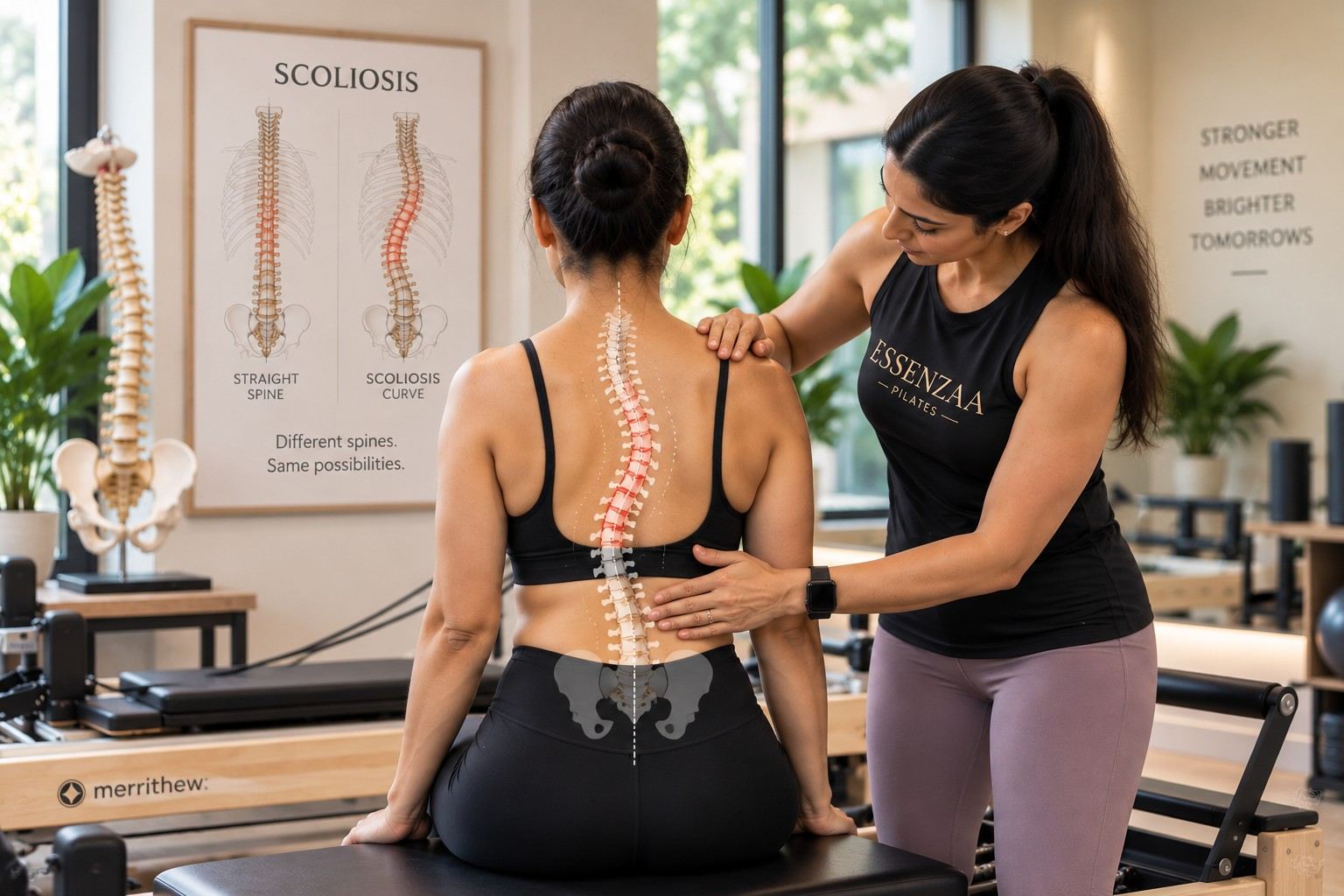
A curved spine does not automatically mean a weak body. And it certainly does not mean you should stop moving.
For many people, discovering that they have scoliosis raises immediate questions.
Can I exercise?
Should I strengthen my back?
Are some movements unsafe?
Can Pilates help scoliosis?
Can exercise straighten my spine?
If you’re considering Pilates for scoliosis, the most important thing to understand is this:
The goal should not simply be to make your body look more symmetrical. The goal is to understand how your body moves and help it become stronger, more capable and more confident.
And that requires more than following a generic list of “scoliosis exercises.”
What Is Scoliosis?
Scoliosis is more than simply having a spine that bends sideways.
It is a three-dimensional spinal deformity that can involve lateral curvature, changes in the normal front-to-back curves of the spine and vertebral rotation. (PubMed)
This is important because scoliosis can affect people differently.
One person may notice an uneven shoulder or hip. Another may experience stiffness or back discomfort. Someone else may have scoliosis visible on an X-ray but experience relatively few symptoms.
In fact, many people with scoliosis are able to lead normal, active lives and participate in exercise and sport. (nhs.uk)
So a diagnosis of scoliosis should not automatically translate into:
“I need to stop exercising.”
It should lead to a better question:
“How should I exercise for my body?”
Does Scoliosis Always Cause Back Pain?
No.
Scoliosis and pain are not the same thing.
Some people with scoliosis experience little or no pain, while back pain can be an important issue for some adults with scoliosis. (nhs.uk)
That distinction matters.
If someone has scoliosis and back pain, we should not automatically assume that every symptom is caused by the spinal curve.
Pain is complex, and an appropriate healthcare assessment may be necessary—particularly when symptoms are new, severe or changing.
Can You Exercise If You Have Scoliosis?
For many people, yes.
General exercise is beneficial for health and typically does not need to be avoided simply because someone has scoliosis. Strength and mobility exercise can help people remain active and maintain physical function. (Mayo Clinic McPress)
But there is an important difference between:
“Exercise is good for scoliosis”
and
“Every exercise is appropriate for every person with scoliosis.”
Those are not the same statement.
The location and severity of the curve, age, symptoms, mobility, strength, medical history and other factors can all influence programming.
This is one reason individual assessment matters before exercise selection.
Can Pilates Help With Scoliosis?
This is where we need to separate promising evidence from exaggerated claims.
Research investigating Pilates and scoliosis has reported improvements in outcomes including pain, range of motion, quality of life and some measures of spinal alignment.
For example, a 2021 meta-analysis included 10 randomized controlled trials involving 359 participants and reported favourable outcomes for Pilates across several measures. However, the researchers specifically cautioned that the overall quality of the evidence was limited. (PubMed)
A later scoping review reached a similarly cautious conclusion: Pilates may have a role, particularly in some people with mild scoliosis, but the evidence concerning scoliosis-related deformity remains limited. (PubMed)
A 2024 systematic review also found promising results for Pilates and spinal posture, while stating that more research is needed. (PubMed)
So the responsible conclusion is:
Pilates may be useful as part of an appropriately designed movement programme for some people with scoliosis.
But we should not promise that Pilates will straighten the spine or cure scoliosis.
Then What Can Pilates Potentially Work On?
Rather than focusing only on the appearance of the spinal curve, an intelligently designed Pilates programme can focus on several trainable physical qualities.
1. Strength
A body with scoliosis still needs strength.
Pilates can progressively challenge the trunk, hips, shoulders and limbs while encouraging control through movement.
Research into core-based exercise for scoliosis has shown potentially beneficial short-term effects, although the overall quality of evidence remains low to very low. (PubMed)
The objective shouldn’t simply be:
“Strengthen your core because you have scoliosis.”
It should be:
Which areas need strength, in which positions, and for which movements?
That is a much more useful question.
2. Movement Awareness
One of Pilates’ most useful characteristics is that movements are performed with attention.
Where is your rib cage moving?
How are you distributing your weight?
What happens to your pelvis when your leg moves?
Can you breathe while maintaining control?
Are you relying excessively on one side?
This does not mean forcing the body into perfect symmetry.
It means developing a better understanding of how your particular body moves.
3. Mobility
Someone with scoliosis may experience stiffness in particular regions while having plenty of movement elsewhere.
That means simply stretching everything is not necessarily the answer.
A thoughtfully designed programme can explore mobility while respecting the individual’s structure, symptoms and available range.
4. Postural Control
“Improve your posture” is frequently misunderstood as:
Stand straight. Pull your shoulders back. Hold yourself there.
Human posture is more complicated.
The objective is not to spend the entire day rigidly holding one supposedly perfect position.
Instead, Pilates can develop the strength, endurance, awareness and movement options needed to support the body in different positions.
Evidence examining Pilates and postural alignment is encouraging in some areas, but certainty varies considerably depending on the population and outcome being studied. (PubMed)
5. Confidence in Movement
This part is easily overlooked.
A diagnosis involving the spine can make some people afraid to move.
They begin questioning every bend, rotation or exercise.
Appropriately guided movement can help someone understand what their body is capable of rather than viewing their spine only through the lens of a diagnosis.
Reformer Pilates for Scoliosis: Is It Better Than Mat Pilates?
People searching for Reformer Pilates for scoliosis often assume the Reformer itself makes the exercise therapeutic.
It doesn’t.
The Reformer is a tool.
Its springs, carriage, straps and other components can provide resistance, assistance and feedback, giving an instructor many ways to modify an exercise.
That can be extremely useful.
But the quality of the programme depends on how the equipment is used, why an exercise has been selected and how it has been adapted for the person.
For one person, a Mat exercise may be appropriate.
For another, the Reformer may provide useful assistance.
For someone else, another apparatus or exercise may be selected.
The apparatus should serve the body—not the other way around.
Why Assessment Matters Before Pilates for Scoliosis
Imagine two women both arrive at a Pilates studio and say:
“I have scoliosis.”
That doesn’t tell an instructor enough to give them identical programmes.
Their spinal curves may differ.
Their symptoms may differ.
One may be physically active and pain-free.
The other may have significant stiffness or pain.
One may need medical or physiotherapy input before beginning.
That is why at Essenzaa we believe movement should begin with understanding before intensity.
Before thinking about how difficult an exercise should be, we want to understand how the person moves today.
Can Pilates Correct Scoliosis?
This deserves a very clear answer.
Do not choose a Pilates programme because someone promises to straighten or cure your scoliosis.
Some studies have reported changes in measures such as Cobb angle following exercise interventions, but the certainty and quality of the evidence remain limited. (PubMed)
Clinical guidance also distinguishes improving strength, function or pain from actually correcting the structural spinal curve. (nhs.uk)
Pilates should therefore not be presented as a replacement for appropriate medical care or scoliosis-specific physiotherapy when those are required.
A better objective is:
Move better.
Build strength.
Develop control.
Maintain mobility.
And become more confident in your body.
When Should You Seek Medical Advice First?
Pilates is not the starting point for every situation.
If you have scoliosis and are experiencing new or severe pain, numbness, tingling, weakness, symptoms extending into the legs, or a noticeable worsening of your condition, seek appropriate medical assessment.
The NHS specifically recommends speaking with a healthcare professional such as a doctor, scoliosis specialist or physiotherapist before starting a new exercise programme if you have scoliosis. (nhs.uk)
And if you have already been prescribed scoliosis-specific rehabilitation, Pilates should not simply replace it.
Pilates may instead be considered within the broader movement strategy where appropriate.
Pilates for Scoliosis in Indore: What Should You Look For?
If you’re searching for Pilates for scoliosis in Indore, don’t choose a studio solely because it owns Reformers.
Ask better questions.
Does the instructor ask about your diagnosis and symptoms?
Do they understand your movement before loading it?
Can exercises be modified?
Are you receiving individual observation and correction?
Is progression based on how you are responding?
And importantly:
Does the instructor recognise when something is outside their scope and needs referral to a healthcare professional?
That last question is a sign of professionalism—not a limitation.
The Essenzaa Approach
At Essenzaa Pilates in Indore, we don’t believe a diagnosis should become an exercise template.
Our programming follows the STOTT PILATES® methodology by Merrithew®, with emphasis on anatomy, alignment, movement quality and intelligent progression.
The Essenzaa teaching standard is led by Sneha Khandelwal, India’s first Full Certified STOTT PILATES® Instructor.
For someone with scoliosis, the objective isn’t to chase a perfectly straight-looking body.
It is to understand the individual in front of us and determine whether—and how—Pilates can appropriately support their movement goals.
Because your X-ray is information about your spine.
It isn’t the complete story of your body.
Frequently Asked Questions
Is Pilates good for scoliosis?
Pilates may help some people with scoliosis work on strength, mobility, movement control and physical function. Research is promising but still limited, particularly regarding changes to the spinal curve itself. (PubMed)
Can Pilates straighten a scoliosis curve?
Pilates should not be promoted as a guaranteed way to straighten or cure scoliosis. Some research has reported changes in Cobb angle, but the certainty of evidence is limited. (PubMed)
Is Reformer Pilates good for scoliosis?
The Reformer can provide resistance, assistance and exercise variations that may be useful for individual programming. However, the important factor is not simply using a Reformer—it is selecting and modifying exercises appropriately for the individual.
Should I do Pilates if scoliosis is causing pain?
Pain should first be understood. If you have significant, persistent or changing symptoms, seek appropriate medical or physiotherapy assessment before beginning a new exercise programme. (nhs.uk)
Can adults with scoliosis exercise?
In many cases, yes. General physical activity is encouraged, and most people with scoliosis can participate in exercise and sport. Individual medical circumstances still matter. (nhs.uk)
Move With Understanding
Scoliosis doesn’t automatically mean you need less movement.
It may mean you need better understood movement.
If you are exploring Pilates for scoliosis in Indore, begin by understanding your body rather than simply searching for exercises online.
At Essenzaa, movement begins with understanding—and progresses with precision.
Essenzaa Pilates | Mahalaxmi Nagar, Indore