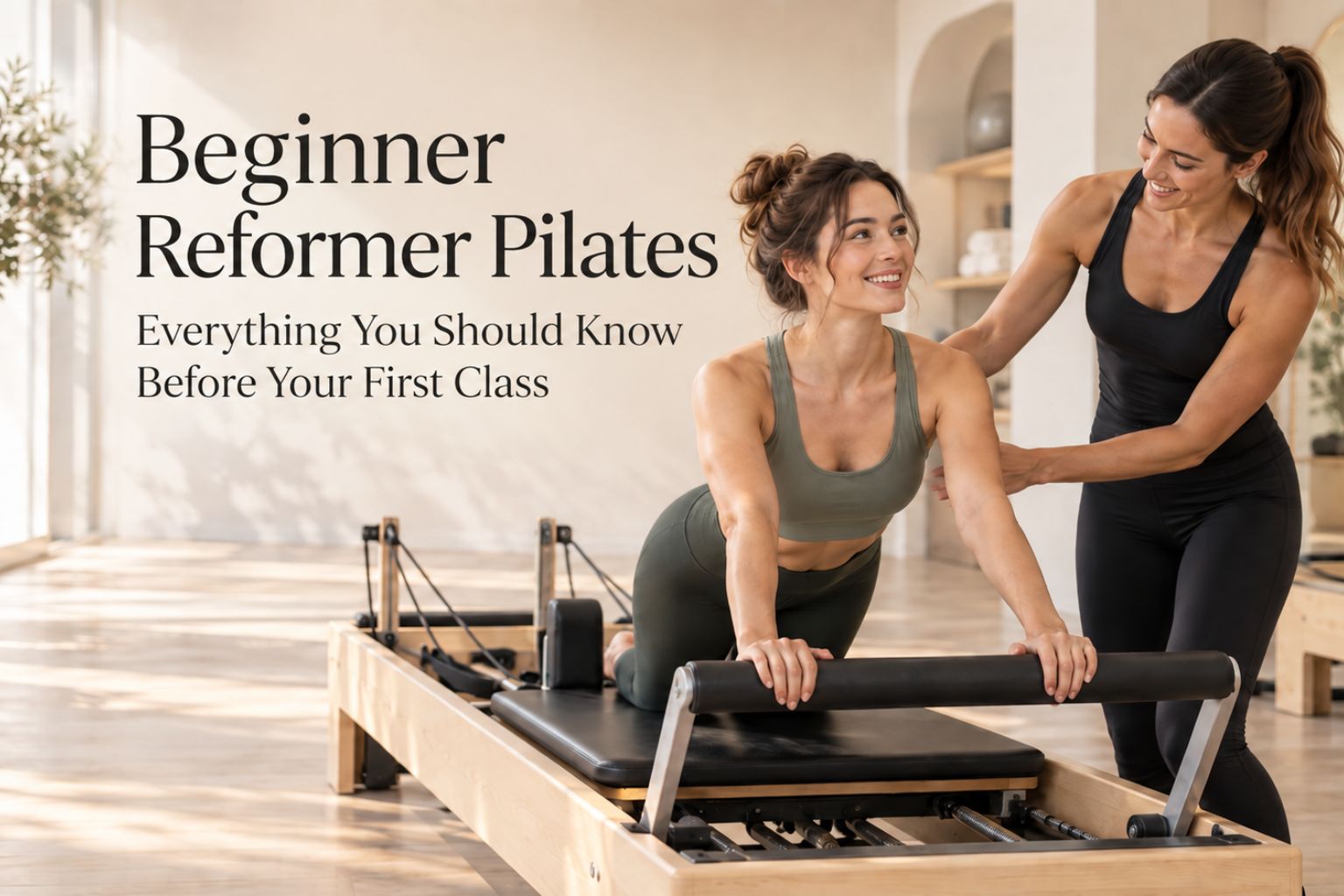
You have seen the Reformer on Instagram. There are springs, straps, a moving carriage and a footbar. People seem to move through exercises smoothly, and from the outside it can look either very elegant or slightly intimidating.
Then comes the obvious question: what actually happens when you are the beginner on that machine?
Many women delay trying Reformer Pilates because they think they need to be flexible, already fit, coordinated or familiar with Pilates before walking into a studio. None of those things are prerequisites for starting. A well taught beginner Reformer Pilates session should meet you where you are and help you understand the equipment, your body and the movement before asking you to do anything complicated.
The bigger issue is not whether you are ‘good at Pilates’. The bigger issue is whether your first experience is taught with enough guidance for you to feel safe, challenged and clear about what you are doing.
First, What Is a Pilates Reformer?
A Pilates Reformer is a specialised piece of equipment built around a moving carriage. Springs create adjustable resistance, while straps, the footbar and other accessories allow exercises to be performed in many positions including lying, sitting, kneeling and standing.
The springs can make an exercise harder, but they can also assist a movement. That is one reason the Reformer can be useful for beginners. The instructor can change the resistance, range, body position and complexity according to the person in front of them.
Merrithew describes the Reformer as equipment that can be adapted for different body sizes, fitness levels and goals, with beginner programming used to develop core stability, peripheral strength and neuromuscular control. The machine is not the method by itself. The method comes from how it is programmed and coached.
Do You Need to Be Fit Before Starting Reformer Pilates?
No. In fact, waiting until you become ‘fit enough for Pilates’ misses the point.
A beginner may arrive after years of inactivity. Another woman may already train in the gym. Someone else may be returning after pregnancy, managing stiffness, or simply looking for an exercise routine she can stay consistent with. All of them are beginners to the Reformer, but they do not have the same starting body.
That is why a good first session should not be a test of how many exercises you can survive. It should establish how you breathe, organise your posture, control the carriage, respond to spring resistance and understand basic cues.
Your first Reformer class should make you understand Pilates, not prove that you are already good at it.
Do You Need to Be Flexible?
This is one of the most common misconceptions. You do not need to touch your toes, sit in a split or have naturally flexible hips to begin Pilates.
Pilates involves both mobility and control. For some people, the priority may be improving movement in a stiff area. For others, the bigger need is stability and strength because they already have plenty of flexibility.
Trying to copy the range of the person beside you can be exactly the wrong approach. A smaller, well controlled movement is often more useful than a large movement achieved through compensation.
What Happens in a Beginner Reformer Pilates Session?
Studios teach differently, but a thoughtful beginner session normally starts with orientation rather than immediately launching into a fast class.
You learn the equipment
You should understand how to get on and off the Reformer, what the springs do, how the footbar works, how to use the straps and where your body should be placed. This sounds basic, but it removes a lot of unnecessary anxiety.
You learn how the instructor communicates
Pilates uses detailed cueing. You may hear instructions about the pelvis, rib cage, shoulders, breathing or head position. At first it can feel like a lot of information. That is normal.
STOTT PILATES® uses five basic biomechanical principles around breathing, pelvic placement, rib cage placement, scapular movement and stabilisation, and head and neck placement. These principles help create a common language for alignment and control.
You begin with foundational movements
A beginner session does not need circus level exercises to be effective. Footwork, simple arm work, controlled trunk movement and basic stability exercises can already be challenging when they are done with precision.
The goal is to understand where the movement is coming from, what should stay stable and how much resistance allows you to work without losing control.
Why Reformer Pilates Can Feel Harder Than It Looks
Pilates has a strange ability to make a small movement feel very demanding.
If you are used to exercise where effort is measured by speed, heavy weight or how exhausted you become, the Reformer may feel different. The challenge often comes from controlling the carriage, keeping alignment while your arms or legs move, and resisting the temptation to use momentum.
A movement can therefore look simple from across the room and feel completely different when your instructor asks you to slow down, breathe and keep the rest of the body organised.
This is also why it is not useful to judge Pilates by how dramatic an exercise looks online. Advanced choreography is not automatically better training.
What Should You Wear to Reformer Pilates?
Comfortable fitted activewear is usually the easiest choice. Clothing does not need to be tight, but very loose fabric can get in the way of straps or make it harder for the instructor to see alignment.
Many studios prefer grip socks for hygiene and traction. Avoid jewellery or accessories that may catch on equipment. Tie long hair back, bring water if you need it, and arrive a little early for your first session so you are not learning the equipment while feeling rushed.
Will Reformer Pilates Help You Lose Weight?
Pilates can contribute to an active lifestyle, but it should not be sold as a magic weight loss method.
Body weight is influenced by many factors including nutrition, total activity, sleep, stress and overall energy balance. Pilates can help you build strength, improve movement quality and create a routine you can consistently follow. Depending on the session style, it can also contribute to your weekly physical activity.
If fat loss is your main goal, think beyond a single workout. A sustainable plan may include Pilates, walking or cardiovascular exercise, appropriate strength training and nutrition that supports your health.
How Often Should a Beginner Do Reformer Pilates?
There is no single frequency that is correct for everyone. For many beginners, two or three well structured sessions each week can provide enough repetition to learn the method while allowing recovery between sessions.
But frequency should depend on your goals, current activity, recovery and whether Pilates is your only form of exercise. A woman who walks daily and strength trains twice a week needs a different plan from someone who is currently inactive.
Consistency matters far more than doing too much in the first two weeks and then disappearing for a month.
Private, Duet or Group Reformer Pilates: Where Should a Beginner Start?
Private Pilates
One to one Pilates can be valuable when you have pain, a complex movement history, a specific condition, significant anxiety about exercise or simply want full individual attention. It also allows the instructor to spend more time teaching the equipment and adapting each exercise.
Duet Pilates
A duet can work well when two people want to train together but still value close coaching. It is especially useful when both clients are comfortable working at slightly different levels within the same session.
Small group Reformer Pilates
Group Pilates can be motivating and social, but class size matters. A beginner needs enough attention to learn how to use the machine safely and understand corrections. The larger the class, the harder it becomes for one instructor to see every detail.
At Essenzaa, the format is selected after understanding the client rather than asking every new person to fit into the same class. Some women are ready for personalised group Reformer Pilates. Others benefit from private guidance first.
What If You Have Back Pain, Knee Pain or Another Condition?
Do not assume that ‘low impact’ automatically means suitable for every condition.
Pilates can be modified extensively, but pain, recent surgery, neurological symptoms, significant injury, pregnancy and other medical considerations may change what is appropriate. Sometimes the right first step is medical or physiotherapy assessment rather than a group exercise class.
Be honest about your history before you begin. An instructor cannot make intelligent choices with information they do not have.
Why Assessment Before Pilates Can Matter
Two beginners can walk into the same studio with the same goal of ‘getting stronger’ and need very different starting points.
One may have limited hip mobility. Another may have very mobile joints but poor control. One may sit ten hours a day. Another may already run and lift weights. One may be confident on equipment. Another may feel nervous even lying on the carriage.
Assessment helps the instructor understand the person before choosing the exercise. That is particularly useful in a method where small changes in alignment, range and spring tension can change the purpose of a movement.
What Makes STOTT PILATES® Different?
STOTT PILATES® is a contemporary approach to Pilates developed by Merrithew. Its teaching incorporates modern exercise principles and places strong emphasis on alignment, breathing, pelvic and rib cage placement, scapular control and appropriate modifications.
For a beginner, the practical value is not the name itself. It is having a structured method that helps the instructor decide how to teach, cue, correct and progress movement rather than relying only on choreography.
At Essenzaa Pilates in Indore, the method is guided by India’s first Full Certified STOTT PILATES® Instructor, with an assessment led approach designed to help clients understand both what they are doing and why.
What Should You Feel After Your First Reformer Class?
You may feel muscles you do not normally notice. You may feel pleasantly challenged, more aware of your posture, or surprised that a slow session required so much concentration.
You do not need to leave shaking, unable to walk or completely exhausted for the session to have value.
A successful first class should leave you with something more useful: a clearer understanding of your body and enough confidence to come back and build on it.
Will You Feel Sore After Your First Class?
You might. A new exercise method can create muscle soreness simply because your body is being asked to work in unfamiliar ways. But extreme soreness is not a badge of a successful Pilates session.
A first class should introduce enough challenge to create learning without turning the next two days into a recovery project. If you are very sore after every session, constantly exhausted, or repeatedly aggravating the same area, the programme may need to be adjusted.
As you become familiar with the method, the goal is to progress the challenge through better control, resistance, range and complexity rather than chasing soreness for its own sake.
How to Choose a Reformer Pilates Studio as a Beginner
The studio environment matters because your first few sessions shape how you understand Pilates. A beautiful room and expensive Reformers are nice, but they do not replace good teaching.
Before joining, look for a studio that can clearly explain who teaches the class, the instructor’s education, class size, how beginners are introduced to the equipment, and what happens if you have pain or need modifications.
Ask whether everybody follows exactly the same programme or whether exercises can be adapted. Notice whether the instructor is able to see the whole class and whether there is enough space and time for correction.
Also pay attention to how the studio speaks about results. Be cautious with promises such as instant weight loss, guaranteed pain relief or dramatic body transformation in a fixed number of sessions. Pilates can be powerful, but bodies do not respond according to marketing timelines.
Common Beginner Mistakes That Are Completely Normal
Beginners often grip the straps too hard, hold their breath, rush the carriage, use more range than they can control, or become so focused on the instructor that they stop noticing what their own body is doing. None of this means you are bad at Pilates. It means you are learning.
Another common mistake is comparing spring settings. More spring is not always harder and less spring is not always easier. The effect depends on the exercise and the direction in which the spring is acting. Copying another person’s setting may completely change the purpose of your exercise.
The fastest way to become more confident is not to memorise the whole repertoire. It is to understand a few basic principles well enough that new exercises start making sense.
Frequently Asked Questions
Is Reformer Pilates good for complete beginners?
Yes, when the session is appropriately taught and progressed. The equipment can be adjusted for different abilities, but beginners still need clear orientation and coaching.
Is Reformer Pilates difficult?
It can be challenging, but difficulty should be appropriate to your current level. Good Pilates is not about making every exercise as hard as possible. It is about keeping control as the challenge increases.
Do I need strong abs before starting?
No. Developing trunk strength and control is part of the process. You do not need to arrive with it already mastered.
Can I do Reformer Pilates if I am overweight?
Body size alone does not determine whether Pilates is appropriate. Equipment limits, comfort, mobility, health conditions and individual goals should be considered by the studio before programming.
How long before I notice a difference?
Some people notice changes in body awareness and movement quite quickly. Strength, endurance, mobility and visible body changes develop over time and depend on consistency, programme quality and what else you do outside the studio.
Should I choose a group class or one to one Pilates?
If you have significant pain, specific limitations, recent rehabilitation or need substantial modification, private Pilates may be the better starting point. A healthy beginner who understands the basics may be suitable for a well supervised small group.
Your First Pilates Class Does Not Need to Be Perfect
You will not remember every cue. You may put your feet in the wrong place. You might forget which way the carriage is moving. That is part of learning.
What matters is that the environment gives you enough guidance to learn without feeling judged or rushed.
At Essenzaa Pilates in Indore, every journey begins with understanding your body before deciding how you should train. The goal is not to make a beginner keep up with Pilates. It is to make Pilates meet the beginner where she is, then progress with clarity.
You do not have to prepare yourself for Pilates. You need Pilates that is prepared for you.
References
Merrithew: STOTT PILATES® Five Basic Principles
Merrithew: STOTT PILATES® Intro to Essential ReformerMerrithew: STOTT PILATES® Frequently Asked Questions